
350-501 · Question #481
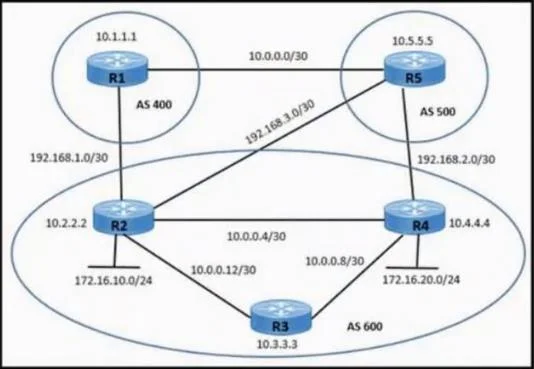
Refer to the exhibit. A network engineer is implementing iBGP and eBGP between AS 600 and AS 500 with these requirements: - R2 must establish eBGP peering on 192.168.3,0/30 with R5 for sending…
The correct answer is D. Configure advertisement-interval 30 in address-family ipv4 multicast. The advertisement-interval command in the BGP configuration is used to set the minimum interval (in seconds) between sending BGP updates for a specific address family. To meet the requirement of waiting 30 seconds before sending multicast BGP updates from R2 to R5, the engineer…
Question
Refer to the exhibit. A network engineer is implementing iBGP and eBGP between AS 600 and AS 500 with these requirements:
- R2 must establish eBGP peering on 192.168.3,0/30 with R5 for sending
unicast and multicast traffic.
- R2 must wait for 30 seconds before sending BGP updates to R5 for
multicast traffic. Which action must be taken on R2 to meet the requirement?
Exhibit
Options
- AApply timers bgp 30 in address-family ipv4 unicast.
- BApply timers bgp 30 in address-family ipv4 multicast.
- CConfigure advertisement-interval 30 in address-family ipv4 unicast.
- DConfigure advertisement-interval 30 in address-family ipv4 multicast.
How the community answered
(42 responses)- A5% (2)
- B7% (3)
- C12% (5)
- D76% (32)
Explanation
The advertisement-interval command in the BGP configuration is used to set the minimum interval (in seconds) between sending BGP updates for a specific address family. To meet the requirement of waiting 30 seconds before sending multicast BGP updates from R2 to R5, the engineer must configure the advertisement-interval 30 under the address-family ipv4 multicast on
Topics
Community Discussion
No community discussion yet for this question.