
350-501 · Question #458
Refer to the exhibit. A company recently deployed a new network using OSPF in the core to share routes. The network administrator selected OSPF as the routing protocol because of its ability to…
The correct answer is D. Configure the MTUs on the interface to match. The failure of the link between R1 and R2 to establish OSPF adjacency, despite normal router boot, is likely due to mismatched Maximum Transmission Unit (MTU) settings on their connected interfaces. OSPF neighbors must have matching MTU values to successfully establish full…
Question
Refer to the exhibit. A company recently deployed a new network using OSPF in the core to share routes. The network administrator selected OSPF as the routing protocol because of its ability to maintain a route database. When the new network was started up, all routers booted normally, but the link between routers R1 and R2 failed to come up. The two routers are located in the same rack at the data center. Which task should an engineer perform to correct the problem?
Exhibit
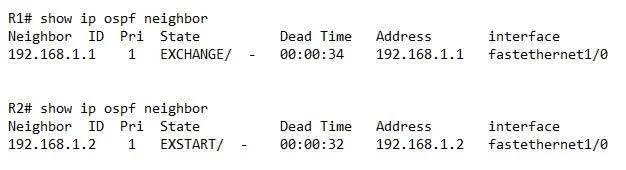
Options
- ASynchronize the dead timers.
- BChange one of the OSPF router IDs so that the router IDs are in different subnets
- CChange the OSPF process ID on one of the devices so that the two IDs match
- DConfigure the MTUs on the interface to match.
How the community answered
(33 responses)- A9% (3)
- B3% (1)
- C3% (1)
- D85% (28)
Why each option
The failure of the link between R1 and R2 to establish OSPF adjacency, despite normal router boot, is likely due to mismatched Maximum Transmission Unit (MTU) settings on their connected interfaces. OSPF neighbors must have matching MTU values to successfully establish full adjacency and exchange routing information.
Mismatched OSPF hello or dead timers would also prevent OSPF adjacency from forming, causing the neighbors to get stuck in the Init or 2-Way state. However, MTU mismatch (D) is a more fundamental issue that can prevent the successful exchange of even small OSPF packets, leading to the "link failed to come up" description.
OSPF router IDs must be unique within an OSPF domain, but they do not need to be in different subnets. Duplicate router IDs would cause issues, but not typically prevent the link from coming up or initial OSPF hellos.
OSPF process IDs are locally significant to a router and do not need to match between neighboring routers for adjacency to form. They are used to distinguish multiple OSPF instances on a single device.
Mismatched MTU (Maximum Transmission Unit) settings on directly connected interfaces is a common reason for OSPF adjacency failure. OSPF performs an MTU check during the ExStart/Exchange state of neighbor establishment; if the MTU values do not match, the routers will get stuck in these states and will not form a full adjacency, effectively causing the "link" for OSPF communication to fail. Ensuring matching MTUs on both R1 and R2 interfaces will allow OSPF adjacency to form correctly.
Concept tested: OSPF adjacency issues - MTU mismatch
Source: https://www.cisco.com/c/en/us/support/docs/ip/open-shortest-path-first-ospf/13689-16.html
Topics
Community Discussion
No community discussion yet for this question.