
350-501 · Question #444
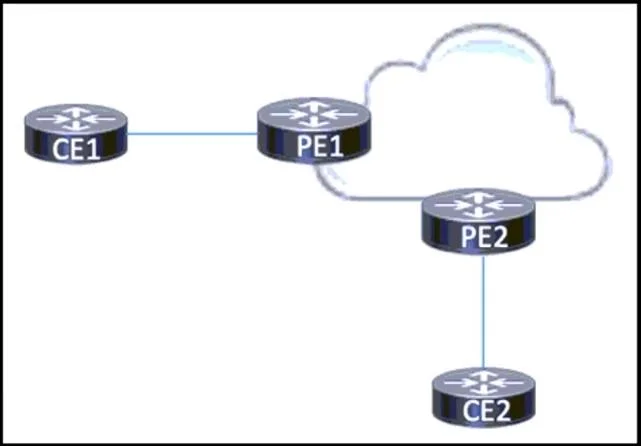
Refer to the exhibit. BGP is running in the core of the service provider to exchange routes for its customers, and OSPF serves as the PE-CE routing protocol. The service provider's existing customer…
The correct answer is A. Configure PE1 and PE2 to mutually redistribute BGP and OSPF in the VRF for the customer. For an MPLS L3 VPN where OSPF is the PE-CE routing protocol, PE1 and PE2 must be configured to mutually redistribute routes between BGP (VPNv4 address family) and OSPF (within the customer's VRF) to ensure full route exchange and connectivity between CE1 and CE2.
Question
Refer to the exhibit. BGP is running in the core of the service provider to exchange routes for its customers, and OSPF serves as the PE-CE routing protocol. The service provider's existing customer at CE1 is opening a new office in a different geographical location connected via CE2. A network engineer must update the BGP implementation so that PE1 and PE2 will share routes and provide communication between CE1 and CE2. Which action must the engineer take?
Exhibit
Options
- AConfigure PE1 and PE2 to mutually redistribute BGP and OSPF in the VRF for the customer
- BConfigure CE1 and CE2 with a pseudowire that will run over the service provider core
- CConfigure PE1 and PE2 to redistribute OSPF from the VRF for the customer into BGP
- DConfigure CE1 and CE2 to establish a BGP relationship with PE1 and PE2
How the community answered
(37 responses)- A81% (30)
- B11% (4)
- C3% (1)
- D5% (2)
Why each option
For an MPLS L3 VPN where OSPF is the PE-CE routing protocol, PE1 and PE2 must be configured to mutually redistribute routes between BGP (VPNv4 address family) and OSPF (within the customer's VRF) to ensure full route exchange and connectivity between CE1 and CE2.
To achieve full connectivity between CE1 and CE2 using OSPF as the PE-CE protocol in an MPLS L3 VPN, the PE routers (PE1 and PE2) must be configured for mutual redistribution, injecting OSPF routes into BGP for VPN propagation and BGP-learned routes back into OSPF for the local CE.
Configuring a pseudowire for CE1 and CE2 would establish a Layer 2 VPN (L2VPN), which is a different solution than updating the BGP implementation for route sharing in a Layer 3 VPN (L3VPN).
Redistributing only OSPF into BGP (one-way) would allow CE routes to propagate across the VPN but would not enable routes learned via BGP from other customer sites to be injected back into the local OSPF domain for the CE.
The question specifies OSPF as the PE-CE routing protocol, so changing to a BGP PE-CE relationship would be a redesign, not an update to the current BGP implementation with OSPF as PE-CE.
Concept tested: MPLS L3 VPN PE-CE OSPF redistribution
Source: https://www.cisco.com/c/en/us/td/docs/ios-xml/ios/mp_l3_vpn/configuration/xe-3s/mp-l3-vpn-xe-3s-book/mp-l3-vpn-config.html
Topics
Community Discussion
No community discussion yet for this question.