
350-501 · Question #440
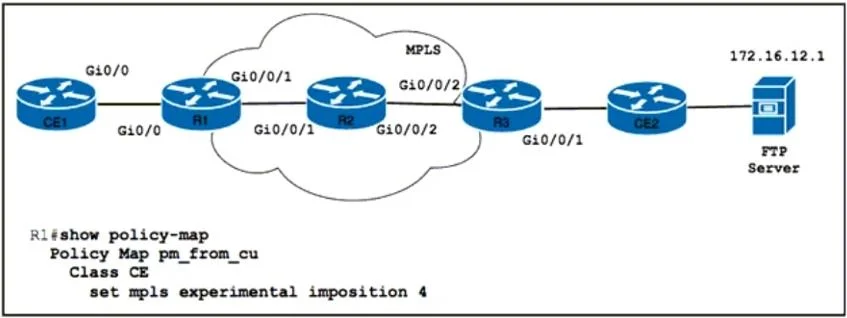
Refer to the exhibit Router R1 is configured with class map CE with match ip precedence critical to align with customer contract SLAs. The customer is sending all traffic from CE1 toward the FTP…
The correct answer is C. Apply a policy map to R3 to reserve 10% of interface bandwidth. E. Implement a class map on R3 to match all packets with QoS IP precedence value 101. To allow 10% of interface capacity on router R3 for customer traffic marked with IP precedence 5, a class map must be created on R3 to match packets with IP precedence value 101, and then a policy map applied to an interface on R3 to reserve the specified bandwidth for this…
Question
Refer to the exhibit Router R1 is configured with class map CE with match ip precedence critical to align with customer contract SLAs. The customer is sending all traffic from CE1 toward the FTP server with IP precedence 5. A network engineer must allow 10% of interface capacity on router R3. Which two actions must the engineer take to accomplish the task? (Choose two.)
Exhibit
Options
- AImplement a class map on R3 to match all packets with QoS IP precedence value 011.
- BImplement a class map on R1 to match all packets with QoS IP precedence value 100.
- CApply a policy map to R3 to reserve 10% of interface bandwidth.
- DApply a policy map to R1 to reserve the remaining 10% of interface bandwidth.
- EImplement a class map on R3 to match all packets with QoS IP precedence value 101.
How the community answered
(45 responses)- A18% (8)
- B4% (2)
- C71% (32)
- D7% (3)
Why each option
To allow 10% of interface capacity on router R3 for customer traffic marked with IP precedence 5, a class map must be created on R3 to match packets with IP precedence value 101, and then a policy map applied to an interface on R3 to reserve the specified bandwidth for this class.
IP precedence value 011 corresponds to value 3 (Flash), not 5 (Critical), so a class map matching this would not identify the correct customer traffic.
The requirement is to configure R3, not R1. Additionally, IP precedence value 100 corresponds to value 4 (Flash-override), not 5.
Applying a policy map to an interface on R3 is the mechanism to reserve or allocate a specific percentage of bandwidth for traffic identified by a class map, directly fulfilling the requirement to allow 10% of interface capacity.
The requirement is to configure R3, not R1, and reserving "remaining 10%" is not the specific task of allowing 10% capacity for a specific traffic class.
Customer traffic is marked with IP precedence 5, which corresponds to the binary value 101. Implementing a class map on R3 that specifically matches `ip precedence 101` correctly identifies the target traffic for bandwidth reservation.
Concept tested: QoS IP Precedence matching and bandwidth reservation
Source: https://www.cisco.com/c/en/us/td/docs/ios-xml/ios/qos_mqc/configuration/xe-3s/qos-mqc-xe-3s-book/qos-mqc-overview.html
Topics
Community Discussion
No community discussion yet for this question.