
350-501 · Question #42
Refer to the exhibit. If router A is the RP, which PIM mode can you configure so that devices will send multicast traffic toward the RP?
The correct answer is A. PIM-SM. PIM-SM (Protocol Independent Multicast-Sparse Mode) is the PIM mode that uses a Rendezvous Point (RP) to enable devices to send multicast traffic towards a central point.
Question
Refer to the exhibit. If router A is the RP, which PIM mode can you configure so that devices will send multicast traffic toward the RP?
Exhibit
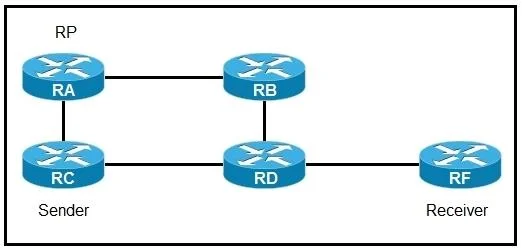
Options
- APIM-SM
- BPIM-DM
- CBIDIR-PIM
- DPIM-SSM
How the community answered
(31 responses)- A87% (27)
- B3% (1)
- C6% (2)
- D3% (1)
Why each option
PIM-SM (Protocol Independent Multicast-Sparse Mode) is the PIM mode that uses a Rendezvous Point (RP) to enable devices to send multicast traffic towards a central point.
PIM-SM is designed for sparse multicast groups where sources and receivers are widely distributed. It utilizes an RP as a meeting point, requiring sources to register with the RP and receivers to join a shared tree rooted at the RP to receive multicast traffic.
PIM-DM (Dense Mode) uses a flood-and-prune mechanism and does not rely on an RP for traffic forwarding.
BIDIR-PIM (Bidirectional PIM) uses an RP but builds bidirectional shared trees, simplifying the RP role by allowing traffic to flow up and down the tree without source registration in the PIM-SM sense.
PIM-SSM (Source Specific Multicast) explicitly uses source-specific trees and does not utilize an RP for forwarding multicast traffic.
Concept tested: PIM-SM and Rendezvous Point function
Source: https://www.cisco.com/c/en/us/td/docs/ios/ipmulti/configuration/guide/imc_pim_cg.html
Topics
Community Discussion
No community discussion yet for this question.