
350-501 · Question #413
Refer to the exhibit. The operations team for a service provider network is implementing a route map policy. OSPF area 0 should originate the default route with a type 2 metric of 2 when the…
The correct answer is A. Apply default-information originate route-map ospf-default-route on router RL. To conditionally originate an OSPF default route based on an application server's status, the default-information originate route-map command must be applied on the router directly connected to and monitoring that server.
Question
Refer to the exhibit. The operations team for a service provider network is implementing a route map policy. OSPF area 0 should originate the default route with a type 2 metric of 2 when the application server on the connected interface (192.168.1.1) is up. Routers RL and RM have set up OSPF peering with other adjacent routers. Which action meets this requirement?
Exhibit
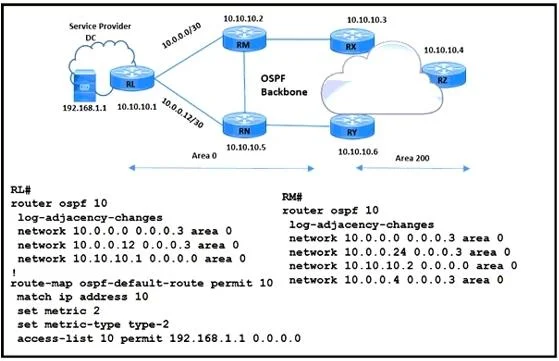
Options
- AApply default-information originate route-map ospf-default-route on router RL.
- BApply default-information originate route-map ospf-default-route on router RM.
- CConfigure distribute-list route-map ospf-default-route out on router RM.
- DConfigure distribute-list route-map ospf-default-route out on router RL.
How the community answered
(52 responses)- A73% (38)
- B17% (9)
- C4% (2)
- D6% (3)
Why each option
To conditionally originate an OSPF default route based on an application server's status, the default-information originate route-map command must be applied on the router directly connected to and monitoring that server.
The default-information originate route-map ospf-default-route command configured on router RL will instruct OSPF to inject a default route (0.0.0.0/0) into Area 0, but only if the specified route-map's conditions are met. Since RL is directly connected to the application server, it is the correct router to implement the conditional default route origination based on the server's availability.
Applying default-information originate route-map ospf-default-route on router RM would make RM the default route originator, but RM is not directly connected to the application server and therefore cannot directly monitor its status for conditional origination.
The distribute-list command is used for filtering routes received or advertised by OSPF, not for originating a default route into the OSPF domain.
Similar to C, distribute-list on RL is for filtering existing routes, not for the conditional origination of a new default route.
Concept tested: OSPF conditional default route origination
Source: https://www.cisco.com/c/en/us/td/docs/ios-xml/ios/iproute_ospf/command/ospf-cr-a-h-book/ospf-cr-a-h-chap1.html#wp4029285743
Topics
Community Discussion
No community discussion yet for this question.