
350-501 · Question #373
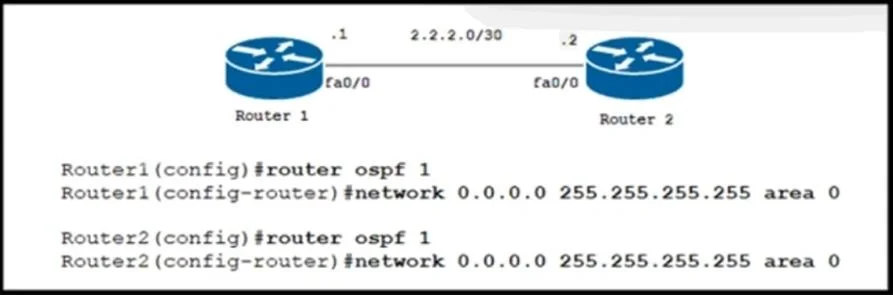
Refer to the exhibit. A network engineer must configure an LDP neighborship between two newly installed routers that are located in two different offices. Router 1 is the core router in the network…
The correct answer is D. Router1(config)#int fa0/0. To establish an LDP neighborship between Router 1 and Router 2, MPLS must be enabled on the fa0/0 interfaces, along with LDP using either mpls ldp autoconfig or mpls ldp interface commands.
Question
Refer to the exhibit. A network engineer must configure an LDP neighborship between two newly installed routers that are located in two different offices. Router 1 is the core router in the network and it has already established OSPF adjacency with router 2. On router 1 and router 2. interface fa0/0 is configured for BFD. Which additional configuration must the engineer apply to the two devices to meet the requirement?
Exhibit
Options
- ARouter1(config)#int fa0/0
- BRouter1(config)#int fa0/0
- CRoute1(config)#int fa0/0
- DRouter1(config)#int fa0/0
How the community answered
(27 responses)- A4% (1)
- C4% (1)
- D93% (25)
Why each option
To establish an LDP neighborship between Router 1 and Router 2, MPLS must be enabled on the fa0/0 interfaces, along with LDP using either `mpls ldp autoconfig` or `mpls ldp interface` commands.
This option provides commands for LDP protocol selection and authentication, but critically lacks the `mpls ip` command to enable MPLS forwarding and a direct LDP enablement command like `mpls ldp autoconfig` or `mpls ldp interface`.
This option includes LDP synchronization and Non-Stop Routing commands, which are advanced features but do not include the fundamental commands to enable MPLS forwarding or basic LDP neighborship.
This option includes LDP router-ID configuration and session protection, which are important aspects but do not provide the foundational commands for enabling MPLS on the interface and LDP neighborship itself.
To establish an LDP neighborship, MPLS forwarding needs to be enabled on the interface using `mpls ip`, and LDP itself must be enabled for label distribution. The `mpls ldp autoconfig` command automates LDP enablement on interfaces where an IGP (like OSPF, already configured) is running, facilitating LDP discovery and session establishment, while `mpls ldp interface` explicitly enables LDP on the specific interface.
Concept tested: MPLS LDP configuration
Source: https://www.cisco.com/c/en/us/td/docs/ios-xml/ios/mp_ldp/configuration/15-mt/mp-ldp-15-mt-book/mp-cfg-ldp-sess-est.html
Topics
Community Discussion
No community discussion yet for this question.