
350-501 · Question #37
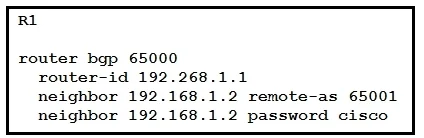
Refer to the exhibit. Router R1 and its peer R2 reside on the same subnet in the network. If an engineer implements this configuration to R1, how does it make connections to R2?
The correct answer is D. R1 establishes TCP connections that are authenticated with an MD5 password. BGP (Border Gateway Protocol) always uses TCP as its transport protocol, specifically TCP port 179. When a 'password' command is configured under a BGP neighbor statement (e.g., 'neighbor x.x.x.x password <string>'), it enables MD5 authentication on the TCP session using RFC…
Question
Refer to the exhibit. Router R1 and its peer R2 reside on the same subnet in the network. If an engineer implements this configuration to R1, how does it make connections to R2?
Exhibit
Options
- AR1 establishes UDP connections that are authenticated with an MD5 password
- BR1 establishes TCP connections that are authenticated with a clear-text password
- CR1 establishes UDP connections that are authenticated with a clear-text password
- DR1 establishes TCP connections that are authenticated with an MD5 password
How the community answered
(33 responses)- B3% (1)
- C3% (1)
- D94% (31)
Explanation
BGP (Border Gateway Protocol) always uses TCP as its transport protocol, specifically TCP port 179. When a 'password' command is configured under a BGP neighbor statement (e.g., 'neighbor x.x.x.x password <string>'), it enables MD5 authentication on the TCP session using RFC 2385. This is not clear-text; the password is used to generate an MD5 hash appended to TCP segments. UDP is never used by BGP. Therefore, R1 establishes TCP connections authenticated with an MD5 password to R2.
Topics
Community Discussion
No community discussion yet for this question.