
350-501 · Question #347
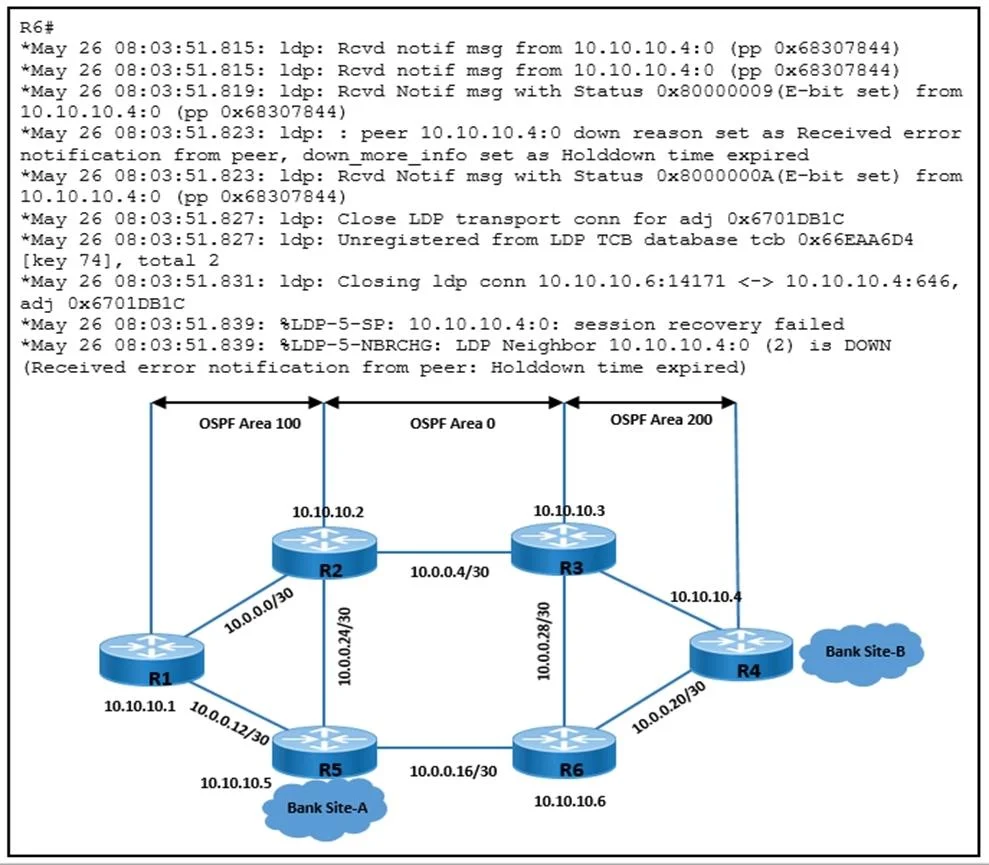
Refer to the exhibit. A network engineer is implementing an LDP-based MPLS solution to enable packet flow between the two bank sites. The engineer was given two requirements: - LDP peering must stay…
The correct answer is D. Configure LDP Session Protection on R4. LDP Session Protection (Option D) is the correct answer because it automatically creates a targeted LDP hello session alongside existing link-based sessions. When a link fails (R3-R6 or R5-R6), the targeted session keeps the LDP peering between R4 and R6 alive and preserves all…
Question
Refer to the exhibit. A network engineer is implementing an LDP-based MPLS solution to enable packet flow between the two bank sites. The engineer was given two requirements:
- LDP peering must stay up when there is a link failure between R3 and
R6
- LDP peering must not flap when there is a link failure between R5 and
R6 Which action meets these requirement?
Exhibit
Options
- AReset the LDP session between R4 and R6.
- BImplement an LDP targeted session with R4 on R6.
- CEnable Link LDP on R4 and R6.
- DConfigure LDP Session Protection on R4.
How the community answered
(23 responses)- A4% (1)
- B9% (2)
- C4% (1)
- D83% (19)
Explanation
LDP Session Protection (Option D) is the correct answer because it automatically creates a targeted LDP hello session alongside existing link-based sessions. When a link fails (R3-R6 or R5-R6), the targeted session keeps the LDP peering between R4 and R6 alive and preserves all label bindings - satisfying both requirements simultaneously with a single configuration on R4.
Why the distractors are wrong:
- A (Reset the session): Tearing down and restarting an LDP session causes the very flapping and outage the requirements forbid - it actively breaks both requirements.
- B (Targeted session on R6): A manually configured targeted session would require both endpoints to initiate or accept it; configuring only R6 is incomplete. More importantly, a raw targeted session lacks the hold-timer protection mechanism that Session Protection provides to absorb transient link failures gracefully.
- C (Link LDP on R4 and R6): Link LDP uses link-local multicast hellos tied directly to an interface - if the interface goes down, the session drops. This is exactly what you are trying to avoid.
Memory tip: Think "Session Protection = Session Survives." When you enable LDP Session Protection, the router builds a targeted backup session to your neighbor before a failure occurs, so when a link dies, the LDP session has a lifeboat already in the water.
Topics
Community Discussion
No community discussion yet for this question.