
350-501 · Question #330
Refer to the exhibit. An engineer at ISP C is configuring a new interconnection with ISPs A and B using the BGP protocol. After the initial configuration, the engineer noticed high memory usage and…
The correct answer is A. Configure the mpls ldp neighbor 11.11.11.11 labels accept 1 command. B. Configure Standard ACL 1 with accepted prefixes. To reduce high memory usage from an excessively large MPLS Label Information Base (LIB) on R2, the engineer must implement LDP label filtering. This involves defining an access control list to specify which prefixes' labels are accepted and then applying that ACL to the LDP…
Question
Refer to the exhibit. An engineer at ISP C is configuring a new interconnection with ISPs A and B using the BGP protocol. After the initial configuration, the engineer noticed high memory usage and an abnormally large LIB table on router R2. Which two actions must the engineer take on R2 to minimize memory usage? (Choose two.)
Exhibit
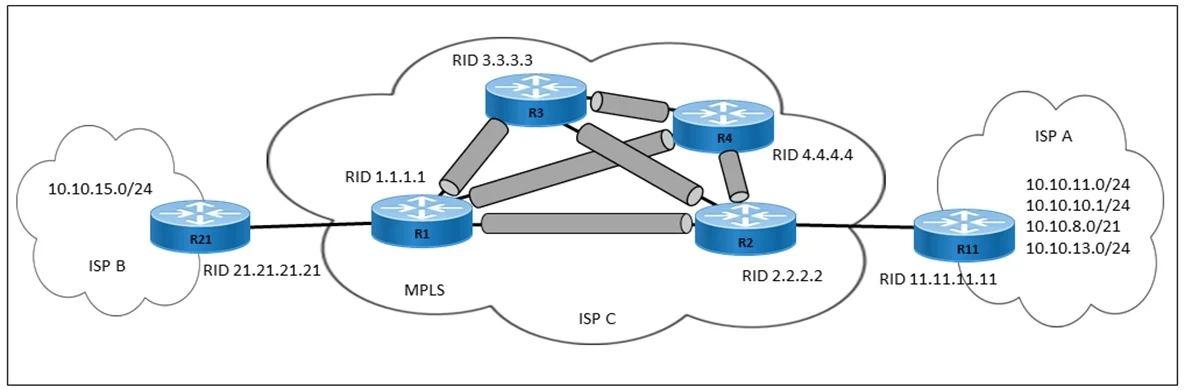
Options
- AConfigure the mpls ldp neighbor 11.11.11.11 labels accept 1 command.
- BConfigure Standard ACL 1 with accepted prefixes.
- CConfigure Extended ACL 101 with accepted prefixes.
- DConfigure the mpls ldp neighbor 1.1.1.1 labels accept 101 command.
- EConfigure the mpls ldp neighbor 21.21.21.21 labels accept 101 command.
How the community answered
(51 responses)- A71% (36)
- C6% (3)
- D8% (4)
- E16% (8)
Why each option
To reduce high memory usage from an excessively large MPLS Label Information Base (LIB) on R2, the engineer must implement LDP label filtering. This involves defining an access control list to specify which prefixes' labels are accepted and then applying that ACL to the LDP neighbor.
This command applies a filter, identified by access-list number 1, to limit the labels accepted from LDP neighbor 11.11.11.11. By only accepting labels for a defined set of prefixes, the router's Label Information Base (LIB) size is reduced, consequently lowering memory consumption.
A standard ACL (like ACL 1) is used to define the specific prefixes for which R2 should accept MPLS labels from its LDP neighbors. By explicitly permitting only the necessary prefixes in this ACL, R2 avoids learning and storing labels for all received prefixes, thereby minimizing LIB growth and memory usage.
While an extended ACL can define prefixes, a standard ACL (like ACL 1, as used in option A) is typically sufficient and simpler for filtering prefixes for LDP label acceptance.
This action applies an extended ACL (ACL 101) to neighbor 1.1.1.1. This could be part of a solution, but without `Configure Extended ACL 101` explicitly mentioned as a required part, it's an incomplete option in context of A and B forming a complete pair.
This action applies an extended ACL (ACL 101) to neighbor 21.21.21.21. Similar to option D, it is an incomplete solution without configuring ACL 101 itself, and (A) and (B) provide a complete and coherent solution using a standard ACL.
Concept tested: MPLS LDP label filtering
Source: https://www.cisco.com/c/en/us/td/docs/ios-xml/ios/mp_ldp/configuration/xe-3s/mp-ldp-xe-3s-book/mp-ldp-labels-filter.html
Topics
Community Discussion
No community discussion yet for this question.