
350-501 · Question #323
Refer to the exhibit. A large organization is merging the network assets of a recently acquired competitor with one of its own satellite offices in the same geographic area. The newly acquired…
The correct answer is A. Attach the route map to the redistribution command to manipulate the routes as they are. After defining a route map for a network merger involving different routing protocols, the engineer must attach the route map to the redistribution command to apply its rules.
Question
Refer to the exhibit. A large organization is merging the network assets of a recently acquired competitor with one of its own satellite offices in the same geographic area. The newly acquired network is running a different routing protocol than the company’s primary network. As part of the merger, a network engineer implemented this route map. Which task must the engineer perform to complete the implementation?
Exhibit
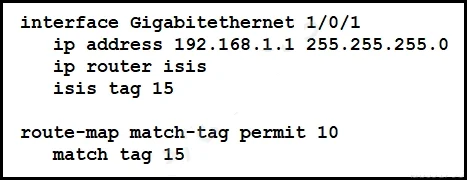
Options
- AAttach the route map to the redistribution command to manipulate the routes as they are
- BEnable metric-style wide to allow the use of extended metrics from the protocols.
- CConfigure an additional route map sequence to override the implicit deny at the end of the route
- DAttach the route map to an IS-IS network statement to advertise the routes learned on this
How the community answered
(37 responses)- A70% (26)
- B3% (1)
- C19% (7)
- D8% (3)
Why each option
After defining a route map for a network merger involving different routing protocols, the engineer must attach the route map to the redistribution command to apply its rules.
A route map, once defined, only becomes active and effective when it is applied to a specific routing process or command that handles route manipulation. In a scenario involving merging networks with different routing protocols, route maps are commonly used with the `redistribute` command to filter or modify routes as they are imported from one routing domain into another. Attaching the route map to the redistribution command ensures that the specified rules are applied to the routes being exchanged between the disparate protocols.
Enabling `metric-style wide` is an IS-IS specific command for extending metric range and is not a general mechanism for applying a route map to manipulate redistributed routes.
Configuring an additional route map sequence is part of *defining* or modifying the route map's logic, not *applying* an already implemented route map to complete its function.
Attaching a route map to an IS-IS `network` statement is incorrect; network statements are used to enable routing on interfaces or advertise networks, not to apply route maps for redistribution.
Concept tested: Route Map Application (Redistribution)
Source: https://www.cisco.com/c/en/us/td/docs/ios-xml/ios/iproute_bgp/configuration/15-mt/irs-15-mt-book/irs-redistribute-bgp.html
Topics
Community Discussion
No community discussion yet for this question.