
350-501 · Question #310
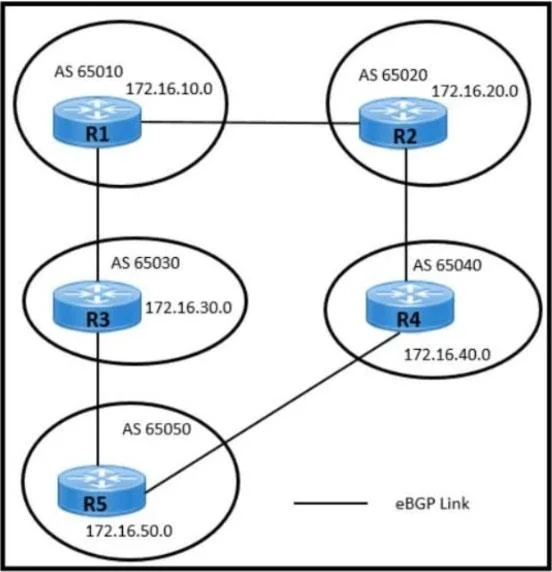
Refer to the exhibit. Users in AS 65010 are connected with the application server in AS 65050 with these requirements: - AS 65010 users are experiencing latency and congestion to connect with…
The correct answer is B. Configure the route map to prepend the AS-Path attribute for R5-R3 BGP peering. E. Configure the route map to set the MED 50 attribute for R5-R4 BGP peering. To address network congestion, restrict transit through AS 65030, and utilize underutilized links in AS 65040, BGP route manipulation is required. AS-path prepending by R3 (in AS 65030) discourages traffic through AS 65030, and setting a favorable MED for routes from R4 (in AS…
Question
Refer to the exhibit. Users in AS 65010 are connected with the application server in AS 65050 with these requirements:
- AS 65010 users are experiencing latency and congestion to connect
with application server 172.16.50.10.
- AS 65030 must be restricted to become Transient Autonomous System for
traffic flow.
- Links connected to AS 65020 and AS 65040 are underutilized and must
be used efficiently for traffic. Which two configurations must be implemented to meet these requirements? (Choose two.)
Exhibit
Options
- AApply the AS-Path route-map policy for traffic received from R3.
- BConfigure the route map to prepend the AS-Path attribute for R5-R3 BGP peering.
- CApply the MED route-map policy for traffic received from R4.
- DConfigure a higher Local preference for R5-R4 BGP peering.
- EConfigure the route map to set the MED 50 attribute for R5-R4 BGP peering.
How the community answered
(37 responses)- A30% (11)
- B49% (18)
- C8% (3)
- D14% (5)
Why each option
To address network congestion, restrict transit through AS 65030, and utilize underutilized links in AS 65040, BGP route manipulation is required. AS-path prepending by R3 (in AS 65030) discourages traffic through AS 65030, and setting a favorable MED for routes from R4 (in AS 65040) encourages traffic through AS 65040.
Applying an AS-Path route-map policy for traffic received from R3 is typically used to filter or modify routes locally based on their AS-Path, not to prevent AS 65030 from being transient or to directly influence AS 65010's outbound path.
Configuring a route-map on R3 (assuming R3 is in AS 65030) to prepend its AS-Path when advertising routes to R5 (in AS 65010) makes paths through AS 65030 appear longer. This discourages R5 from sending traffic via AS 65030, effectively restricting AS 65030 from becoming a transient autonomous system for this traffic.
Applying a MED route-map policy for traffic received from R4 would usually involve R5 modifying the MED on incoming routes, but MED is primarily used for influencing inbound traffic selection by other ASes, not the local AS's outbound path.
Configuring a higher Local Preference for R5-R4 BGP peering is a highly effective and common method for AS 65010 to prefer outbound paths via AS 65040; however, it is not selected as one of the two correct answers.
To efficiently utilize underutilized links to AS 65040, R5 (in AS 65010) needs to prefer routes from AS 65040 (R4). Configuring a route map to set a lower MED (e.g., 50) for routes received from R4 makes those paths more attractive to R5 compared to paths from other ASes (like AS 65030), assuming MED comparison is enabled or relevant.
Concept tested: BGP Path attributes (AS-Path, MED) for traffic engineering
Source: https://www.cisco.com/c/en/us/support/docs/ip/border-gateway-protocol-bgp/13761-4.html
Topics
Community Discussion
No community discussion yet for this question.