
350-501 · Question #291
Refer to the exhibit. The USER that is connecting an application on an Internet connection in AS 100 is facing these issues: - The USER lost the connection to the application during a failure…
The correct answer is D. Apply low Local Preference on R4 toward R2. To resolve connection loss during R2 failures and establish a preferred path via R1, the engineer should apply a low Local Preference on R4 for routes learned from R2, ensuring traffic is steered through R1.
Question
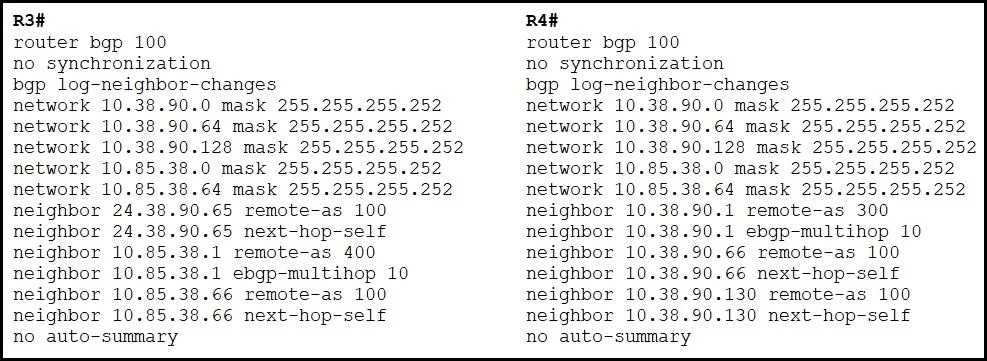
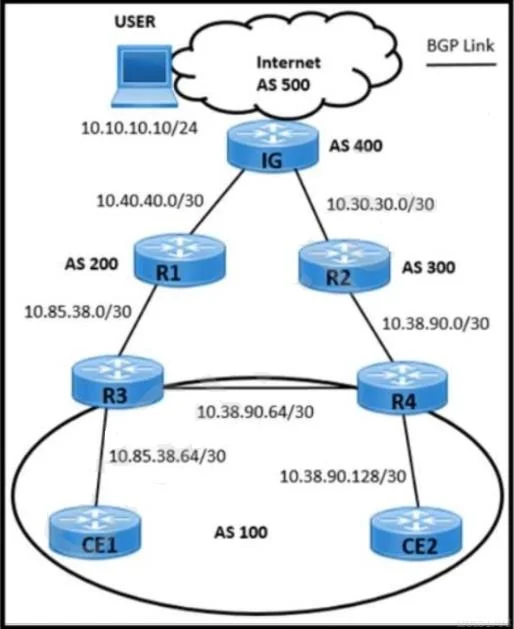
Refer to the exhibit. The USER that is connecting an application on an Internet connection in AS 100 is facing these issues:
- The USER lost the connection to the application during a failure
between IG and R2.
- Router R2 configuration is lost due to a power outage.
- The application the USER is connecting to is hosted behind CE2.
What action resolves the issues on R3 and R4 routers?
Exhibits
Options
- ASet R4 as a route reflector for R3 and CE2
- BApply high Local Preference on R3 toward R1
- CSet R3 as a route reflector for R4 and CE1
- DApply low Local Preference on R4 toward R2.
How the community answered
(28 responses)- A7% (2)
- B4% (1)
- C14% (4)
- D75% (21)
Why each option
To resolve connection loss during R2 failures and establish a preferred path via R1, the engineer should apply a low Local Preference on R4 for routes learned from R2, ensuring traffic is steered through R1.
Setting R4 as a route reflector for R3 and CE2 addresses iBGP full-mesh requirements but does not inherently create a preferred path or solve the specific redundancy issue for user connection outages caused by R2 failures.
Applying a high Local Preference on R3 toward R1 influences R3's outbound path selection, but the issue described pertains to the user's connection in AS 100 to an application behind CE2, primarily involving R4's path selection towards CE2.
Setting R3 as a route reflector for R4 and CE1 addresses iBGP full-mesh requirements, but it does not directly solve the problem of path preference for user traffic to CE2 or provide specific redundancy for R2's failure.
Applying a low Local Preference on R4 for routes learned from R2 will cause R4 to prefer alternative paths (e.g., through R1) that have a higher Local Preference value. This establishes a primary path through R1, providing redundancy and ensuring continuous connectivity to the application behind CE2 even if R2 experiences failures or configuration loss.
Concept tested: BGP Local Preference for path manipulation and redundancy
Source: https://www.cisco.com/c/en/us/td/docs/ios-xml/ios/iproute_bgp/configuration/15-mt/bgp-15-mt-book/bgp-path-attr.html
Topics
Community Discussion
No community discussion yet for this question.