
350-501 · Question #250
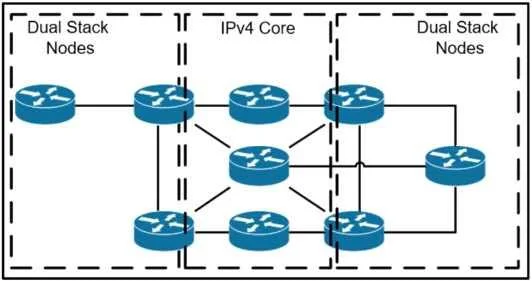
Refer to the exhibit. A network operator has two IPv4 and IPv6 dual-stacked network on each side of the IPv4 core network. The operator must be able to provide connectivity between them while using…
The correct answer is B. NAT46. To provide IPv6 connectivity between two dual-stacked networks separated by an IPv4-only core, utilizing specific assigned IPv6 address space, NAT46 can be used to translate IPv6 packets to IPv4 and back for core transit.
Question
Refer to the exhibit. A network operator has two IPv4 and IPv6 dual-stacked network on each side of the IPv4 core network. The operator must be able to provide connectivity between them while using specific assigned IPv6 space provided from the company IP administrator team. Which technology should the network operator use to accomplish this goal?
Exhibit
Options
- A6rd
- BNAT46
- CDS-Lite
- DNAT44
How the community answered
(61 responses)- A5% (3)
- B70% (43)
- C10% (6)
- D15% (9)
Why each option
To provide IPv6 connectivity between two dual-stacked networks separated by an IPv4-only core, utilizing specific assigned IPv6 address space, NAT46 can be used to translate IPv6 packets to IPv4 and back for core transit.
6rd (IPv6 Rapid Deployment) is typically an ISP-side mechanism to provide IPv6 connectivity to customers over an existing IPv4 infrastructure, often involving algorithmic mapping of IPv6 addresses derived from IPv4 addresses, which may not align with using 'specific assigned IPv6 space' for network-to-network connectivity.
NAT46 translates IPv6 addresses and packet headers to IPv4 and vice-versa, enabling IPv6 hosts in dual-stacked networks to communicate across an IPv4-only core. This mechanism allows the use of specific assigned IPv6 space by mapping it during the translation process across the core network.
DS-Lite (Dual-Stack Lite) is designed to provide IPv4 connectivity to customer devices over an IPv6-only access network, which is the reverse scenario of the problem described.
NAT44 is an IPv4-to-IPv4 address translation technique used primarily for IPv4 address conservation or security within an IPv4 network, having no direct relevance to enabling IPv6 connectivity across an IPv4 core.
Concept tested: IPv6 transition mechanisms (NAT46 for IPv6 over IPv4 core)
Source: https://www.cisco.com/c/en/us/td/docs/ios-xml/ios/ipaddr_nat/configuration/xe-3s/nat-xe-3s-book/iad-nat64.html
Topics
Community Discussion
No community discussion yet for this question.