
350-501 · Question #25
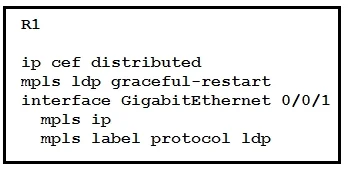
Refer to the exhibit. Which effect of this configuration is true?
The correct answer is A. R1 can support a peer that is configured for LDP SSO/NSF as the peer recovers from an outage. When ldp graceful-restart is enabled, R1 can support non-stop forwarding (NSF) functionality, allowing it to maintain LSP forwarding when a peer recovers from an outage.
Question
Refer to the exhibit. Which effect of this configuration is true?
Exhibit
Options
- AR1 can support a peer that is configured for LDP SSO/NSF as the peer recovers from an outage
- BR1 can failover only to a peer that is configured for LDP SSO/NSF
- CR1 can failover to any peer
- DR1 can support a graceful restart operation on the peer, even if graceful restart is disabled on the
How the community answered
(44 responses)- A95% (42)
- B2% (1)
- D2% (1)
Why each option
When `ldp graceful-restart` is enabled, R1 can support non-stop forwarding (NSF) functionality, allowing it to maintain LSP forwarding when a peer recovers from an outage.
Enabling LDP graceful restart on R1 configures it to operate in a way that tolerates LDP session restarts with its peers. This means if a peer router configured for LDP SSO/NSF goes down and comes back up, R1 will continue to forward traffic using the established labels during the graceful restart period, preventing traffic disruption.
LDP graceful restart allows R1 to support a peer undergoing NSF/SSO, but it does not restrict R1's failover capability only to such peers.
LDP graceful restart is specific to maintaining LSPs during peer outages with NSF-capable peers and does not imply failover capability to any peer in a general sense, nor is it about routing protocol failover.
The statement implies R1 can support a graceful restart on a peer even if graceful restart is disabled on R1, which is incorrect; both ends generally need to negotiate graceful restart capability for it to function effectively.
Concept tested: LDP graceful restart functionality
Source: https://www.cisco.com/c/en/us/td/docs/ios/mpls/configuration/guide/12_4t/t_mpls_12_4t_book/t_mpls_mpls_ldp.html
Topics
Community Discussion
No community discussion yet for this question.