
350-501 · Question #248
Refer to the exhibit. An engineer has started to configure a router for OSPF, as shown Which configuration must an engineer apply on the network so that area 15 traffic from R5 to R1 will prefer the…
The correct answer is C. Implement a multiarea adjacency on the link between R2 and R4, with the cost manipulated to. To ensure traffic from R5 in Area 15 prefers the route through R4 to reach R1, the engineer must manipulate the OSPF cost associated with the path through R4, making it more favorable than the path through R3.
Question
Refer to the exhibit. An engineer has started to configure a router for OSPF, as shown Which configuration must an engineer apply on the network so that area 15 traffic from R5 to R1 will prefer the route through R4?
Exhibit
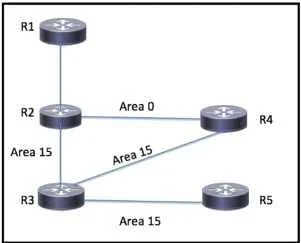
Options
- APlace the link between R3 and R5 in a stub area to force traffic to use the route through R4.
- BIncrease the cost on the link between R2 and R4, to influence the path over R3 and R4.
- CImplement a multiarea adjacency on the link between R2 and R4, with the cost manipulated to
- DImplement a sham link on the between R3 and R2 to extend area 0 area 15.
How the community answered
(55 responses)- A5% (3)
- B13% (7)
- C78% (43)
- D4% (2)
Why each option
To ensure traffic from R5 in Area 15 prefers the route through R4 to reach R1, the engineer must manipulate the OSPF cost associated with the path through R4, making it more favorable than the path through R3.
Placing a link in a stub area restricts the types of routes that can be advertised into it and generally injects a default route, which does not provide granular control over preference between two inter-area paths.
Increasing the cost on the link between R2 and R4 would make the path through R4 more expensive, which is the opposite of the desired outcome to prefer R4.
To influence OSPF path preference, the primary method is to manipulate the cost of the links. By adjusting the cost on the link between R2 and R4 (or other relevant links in the path through R4), the engineer can make the cumulative path cost via R4 lower than via R3, causing R5 to prefer R4 for reaching R1.
A sham link is used to connect two OSPF routers that belong to the same OSPF area but are separated by an MPLS VPN backbone, typically to resolve reachability issues for OSPF adjacencies over a VPN, and is not used for direct path preference manipulation between areas in this context.
Concept tested: OSPF inter-area path preference and cost manipulation
Source: https://www.cisco.com/c/en/us/td/docs/ios/iproute_ospf/configuration/guide/12_4t/iro_c1.html
Topics
Community Discussion
No community discussion yet for this question.