
350-501 · Question #183
Refer to the exhibit. While troubleshooting a connectivity issue on router R2, a network engineer with an employee id:3876.13.497 notices that although it detects three OSPF links from R1, the OSPF…
The correct answer is C. The R2 Serial 1/0 interface is configured with an IP address, but the R1 Serial R1 Serial 1/0. The absence of OSPF prefixes in R2's routing table, despite detecting OSPF links from R1, most fundamentally indicates a problem with R1's Serial 1/0 interface having no IP address, preventing proper adjacency and route exchange.
Question
Refer to the exhibit. While troubleshooting a connectivity issue on router R2, a network engineer with an employee id:3876.13.497 notices that although it detects three OSPF links from R1, the OSPF prefixes are missing from the routing table. What is the reason for the problem?
Exhibit
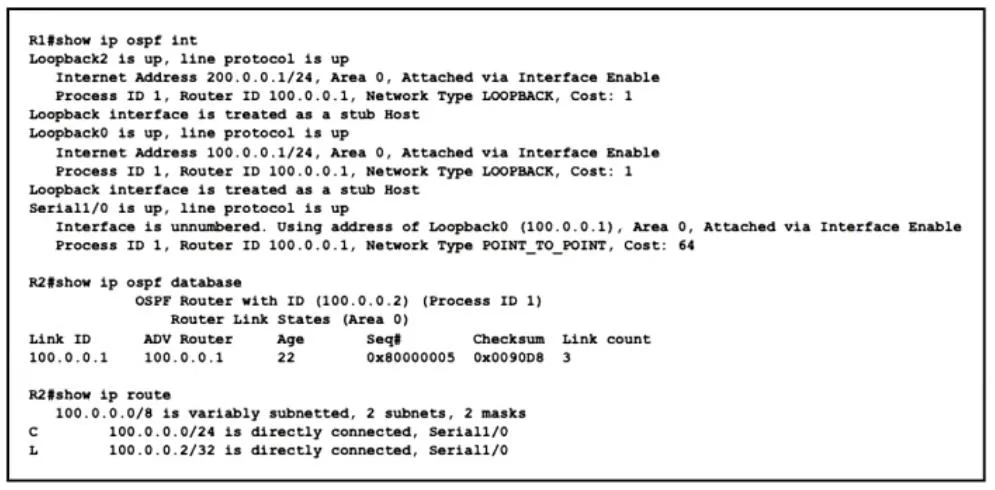
Options
- AThe serial interfaces have different MTUs
- BBoth loopback interfaces on R1 are configured as stub
- CThe R2 Serial 1/0 interface is configured with an IP address, but the R1 Serial R1 Serial 1/0
- DThe subnet masks on the serial interfaces are mismatched.
How the community answered
(36 responses)- A3% (1)
- B6% (2)
- C78% (28)
- D14% (5)
Why each option
The absence of OSPF prefixes in R2's routing table, despite detecting OSPF links from R1, most fundamentally indicates a problem with R1's Serial 1/0 interface having no IP address, preventing proper adjacency and route exchange.
Different MTUs can prevent OSPF adjacency from forming or cause packet fragmentation issues, but a missing IP address is a more fundamental reason for complete failure to establish an adjacency and exchange routes.
Loopback interfaces configured as stub on R1 would not prevent R2 from learning other OSPF prefixes advertised by R1 through its serial interfaces; loopbacks are typically used for router IDs and network advertisement, not directly for neighbor adjacency formation on serial links.
If R1's Serial 1/0 interface, which R2 is trying to form an OSPF adjacency with, is configured as part of the OSPF process but lacks an IP address, then a full OSPF adjacency cannot form, and R1 will not exchange its OSPF prefixes with R2, leading to missing routes in R2's routing table.
Mismatched subnet masks on directly connected serial interfaces will prevent OSPF adjacency from forming, similar to MTU issues, but a complete absence of an IP address on an interface is a more primary and absolute barrier to adjacency formation and route exchange.
Concept tested: OSPF adjacency requirements and troubleshooting
Source: https://www.cisco.com/c/en/us/support/docs/ip/open-shortest-path-first-ospf/13689-18.html
Topics
Community Discussion
No community discussion yet for this question.