
350-501 · Question #137
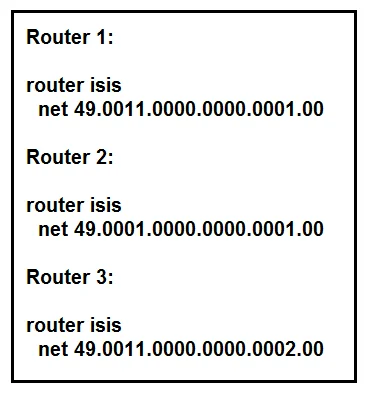
Refer to the exhibit. Router 4 is added to the network and must be in the same area as router 1. Which NET should the engineer assign?
The correct answer is C. 49.0011.0000.0000.0003.00. To place Router 4 in the same IS-IS area as Router 1, its Network Entity Title (NET) must share the same Area ID as Router 1 but have a unique System ID.
Question
Refer to the exhibit. Router 4 is added to the network and must be in the same area as router 1. Which NET should the engineer assign?
Exhibit
Options
- A49.0001.0000.0000.0004.00
- B49.0111.0000.0000.0001.00
- C49.0011.0000.0000.0003.00
- D49.0011.0000.0000.0002.00
How the community answered
(70 responses)- A10% (7)
- B16% (11)
- C70% (49)
- D4% (3)
Why each option
To place Router 4 in the same IS-IS area as Router 1, its Network Entity Title (NET) must share the same Area ID as Router 1 but have a unique System ID.
This NET uses Area ID '0001', which would place Router 4 in a different IS-IS area than Router 1 (assuming Router 1 is in Area '0011').
This NET uses Area ID '0111', which would place Router 4 in a different IS-IS area than Router 1.
While this NET shares the correct Area ID '0011', its System ID '0000.0000.0002' might already be in use by another router (e.g., Router 2) within the same area, violating the uniqueness requirement for System IDs.
Concept tested: IS-IS NET address structure and Area ID
Source: https://www.cisco.com/c/en/us/td/docs/ios/iproute_isis/configuration/guide/15_0s/irs_15_0s_book/irs_basic_config.html
Topics
Community Discussion
No community discussion yet for this question.