
350-501 · Question #134
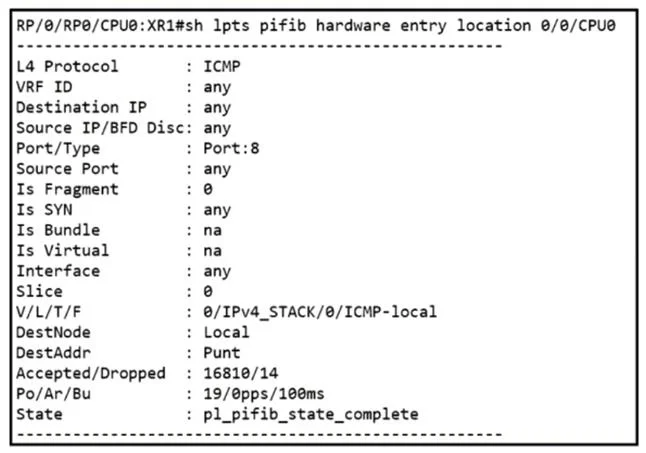
Refer to the exhibit. While troubleshooting the network, a network operator with an employee id: 3812:12:993 is trying to ping XR1. Which result should the operator expect when trying to ping to an…
The correct answer is B. All ICMP traffic responds successfully. When pinging a local address on a Cisco XR router, all ICMP traffic typically responds successfully by default.
Question
Refer to the exhibit. While troubleshooting the network, a network operator with an employee id:
3812:12:993 is trying to ping XR1. Which result should the operator expect when trying to ping to an XR1 local address?
Exhibit
Options
- AICMP traffic works at a policed rate of 19 bytes per second every 100 ms
- BAll ICMP traffic responds successfully.
- CAll ICMP traffic is dropped.
- DICMP traffic works at a policed rate of 19 packets every 100 ms.
How the community answered
(48 responses)- A13% (6)
- B60% (29)
- C6% (3)
- D21% (10)
Why each option
When pinging a local address on a Cisco XR router, all ICMP traffic typically responds successfully by default.
Working at a policed rate of 19 bytes per second every 100 ms implies a specific, non-default control-plane policing configuration.
All ICMP traffic being dropped would only occur if a restrictive control-plane policy or ACL was applied to block all pings, which is not the default behavior.
Working at a policed rate of 19 packets every 100 ms suggests a specific, non-default control-plane policing configuration, distinct from the default full response.
Concept tested: Default router control plane behavior (ICMP)
Source: https://www.cisco.com/c/en/us/td/docs/routers/asr9000/software/asr9k-r6-6/security/configuration/guide/b-security-cg-asr9000-66x/b-security-cg-asr9000-66x_chapter_011.html
Topics
Community Discussion
No community discussion yet for this question.