
350-501 · Question #124
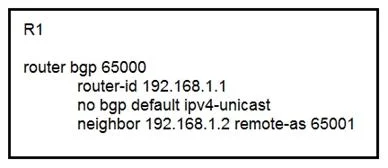
Refer to the exhibit. Which task completes the configuration?
The correct answer is C. Specify the activate neighbor 192.168.1.2 under the IPv4 address family. For a BGP neighbor defined globally under the BGP process, it must be explicitly activated within an address family to exchange routes for that family.
Question
Refer to the exhibit. Which task completes the configuration?
Exhibit
Options
- ASpecify the maximum number of prefixes that R1 receives from neighbor 192.168.1.2.
- BSpecify the source interface in the neighbor statement.
- CSpecify the activate neighbor 192.168.1.2 under the IPv4 address family.
- DSpecify the local-as value in the neighbor statement.
How the community answered
(49 responses)- A2% (1)
- B4% (2)
- C88% (43)
- D6% (3)
Why each option
For a BGP neighbor defined globally under the BGP process, it must be explicitly activated within an address family to exchange routes for that family.
Specifying the maximum number of prefixes is a control measure to prevent issues, not a fundamental step to complete basic BGP peering and route exchange.
While `update-source` is good practice for BGP neighbor stability, especially when peering over loopbacks, it is not strictly necessary to complete the basic peering if the source interface can be inferred.
Even after defining a BGP neighbor globally, it must be explicitly activated within the relevant address family (e.g., `address-family ipv4`) to enable it to exchange routes for that specific IP version and type.
Specifying a `local-as` value is typically used for AS-path manipulation in specific scenarios like private AS removal or AS override, not for the basic completion of a BGP peering session.
Concept tested: BGP Neighbor Activation
Source: https://www.cisco.com/c/en/us/td/docs/ios/iproute_bgp/configuration/guide/irg_bgp.html
Topics
Community Discussion
No community discussion yet for this question.