
350-501 · Question #10
Refer to the exhibit. Which command is used to complete this configuration for QoS class-based marking?
The correct answer is A. PE-A(config-pmap-c)#set dscp ef. To complete a QoS class-based marking configuration within a policy-map class, the set dscp ef command is used to mark packets with the Expedited Forwarding (EF) DSCP value.
Question
Refer to the exhibit. Which command is used to complete this configuration for QoS class-based marking?
Exhibit
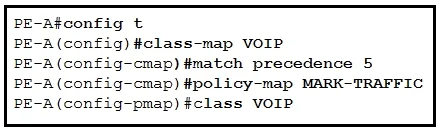
Options
- APE-A(config-pmap-c)#set dscp ef
- BPE-A(config-pmap-c)#fair-queue
- CPE-A(config-pmap-c)#random-detect
- DPE-A(config-pmap-c)#priority
How the community answered
(22 responses)- A86% (19)
- B5% (1)
- D9% (2)
Why each option
To complete a QoS class-based marking configuration within a policy-map class, the `set dscp ef` command is used to mark packets with the Expedited Forwarding (EF) DSCP value.
The `set dscp ef` command is used within a class configuration under a policy-map to mark packets belonging to that class with the Expedited Forwarding (EF) Differentiated Services Code Point (DSCP) value, a common action for QoS classification.
`fair-queue` is a queuing mechanism, not a marking command, and dictates how packets are queued rather than how they are classified or marked.
`random-detect` refers to congestion avoidance mechanisms like Random Early Detection (RED) or Weighted RED (WRED), not a marking command.
`priority` is a queuing command used to assign priority queuing to a class of traffic, guaranteeing bandwidth and preference, but it is not a marking command itself.
Concept tested: QoS class-based marking (DSCP)
Source: https://www.cisco.com/c/en/us/td/docs/ios-xml/ios/qos/configuration/xe-3s/qos-xe-3s-book/qos-classify-mark.html
Topics
Community Discussion
No community discussion yet for this question.