
350-401 · Question #981
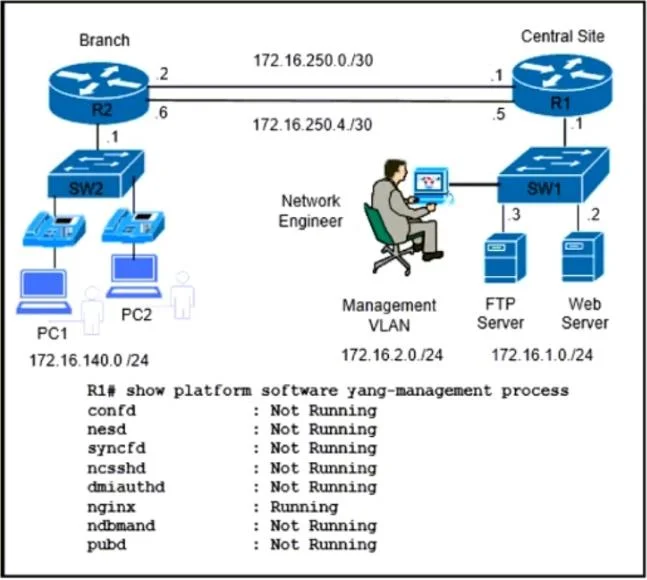
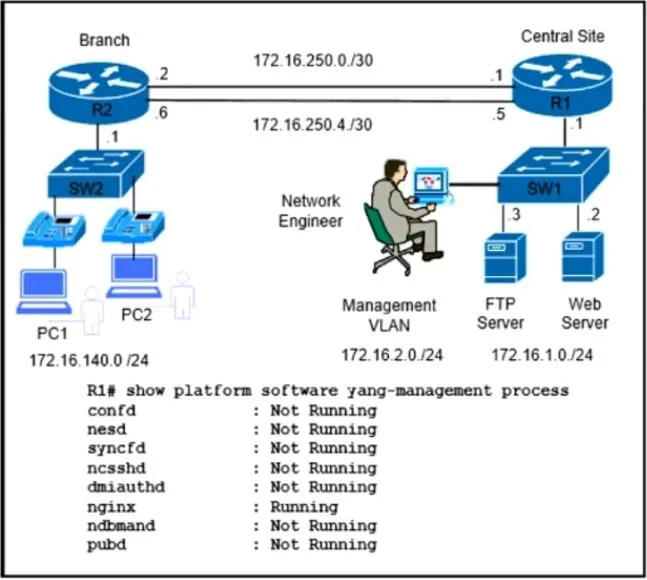
Refer to the exhibit. Which command is required on router R1 to start receiving RESTCONF requests?
The correct answer is C. R1(config)# restconf. Explanation Enabling RESTCONF on a Cisco IOS-XE router requires the dedicated restconf command in global configuration mode, which activates the RESTCONF programmatic interface and allows the router to accept API requests over HTTPS. While RESTCONF does rely on HTTP/HTTPS…
Question
Refer to the exhibit. Which command is required on router R1 to start receiving RESTCONF requests?
Exhibits
Options
- AR1(config)# ip http accounting commands 12 default
- BR1(config)# ip http server
- CR1(config)# restconf
- DR1(config)# ip http access-class 12
How the community answered
(15 responses)- A7% (1)
- C93% (14)
Explanation
Explanation
Enabling RESTCONF on a Cisco IOS-XE router requires the dedicated restconf command in global configuration mode, which activates the RESTCONF programmatic interface and allows the router to accept API requests over HTTPS. While RESTCONF does rely on HTTP/HTTPS transport, simply enabling the HTTP server with ip http server (Option B) alone is not sufficient - the restconf command is the specific trigger that enables the RESTCONF subsystem. Options A and D are HTTP accounting and access-class commands respectively, which are optional security/management configurations that have nothing to do with initially enabling RESTCONF functionality. It's also worth noting that in practice, both restconf and ip http secure-server are typically needed together, but among the given choices, restconf is the required command being tested here.
Memory Tip: Think of it simply - to enable a feature by name, use the feature's name as the command. RESTCONF →
restconf, just like enabling NETCONF uses thenetconf-yangcommand. When in doubt, the dedicated feature command is always the answer over generic supporting commands.
Topics
Community Discussion
No community discussion yet for this question.