
350-401 · Question #841
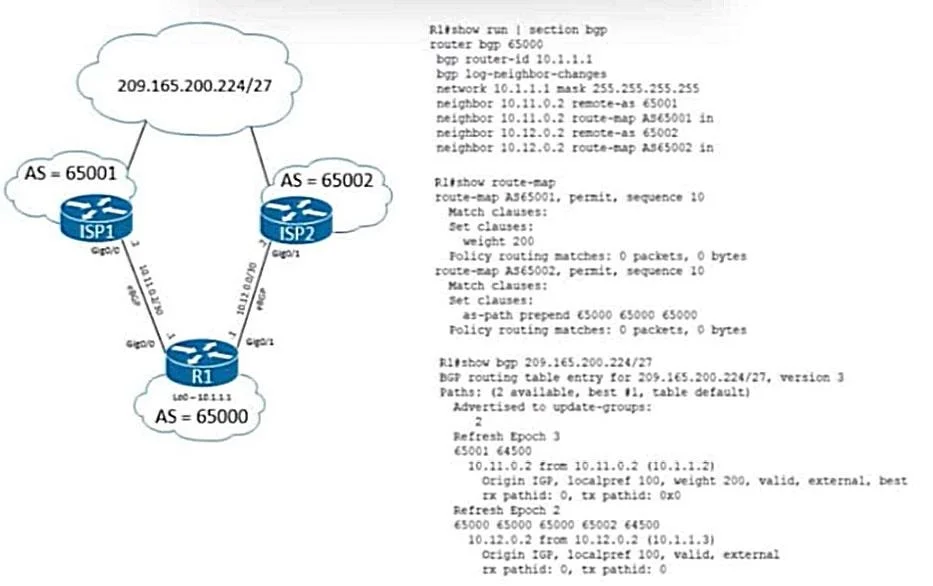
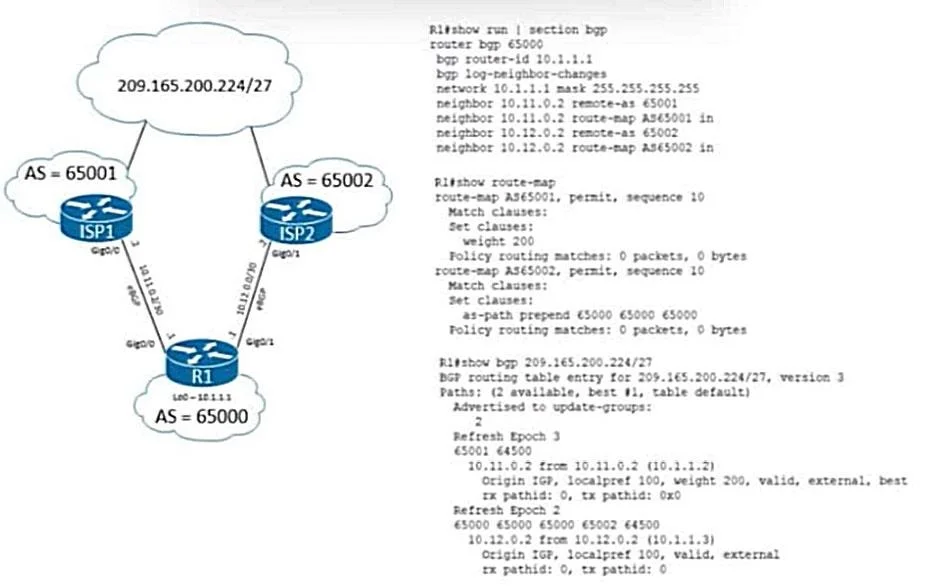
Refer to the exhibit. A client has two directly connected eBGP peering links with diverse ISPs. Both providers advertise the same public prefix 209.165.200.224/27 to R1 without any route…
The correct answer is C. R1#config t R1(config)#router bgp 65000 R1(config-router)# neighbor 10.12.0.2 route-map AS65002 out. Option C is correct because it applies a route-map outbound to the ISP2 neighbor (10.12.0.2), which is used to prepend AS path or manipulate attributes advertised TO ISP2, making ISP1 the preferred inbound path for return traffic. By applying an outbound route-map to the ISP2…
Question
Refer to the exhibit. A client has two directly connected eBGP peering links with diverse ISPs. Both providers advertise the same public prefix 209.165.200.224/27 to R1 without any route manipulation. Traffic leaves R1 outbound via ISP1 but returns inbound via ISP2. Which configuration prevents asymmetrical routing and makes ISP1 the preferred path inbound and outbound? A. B. C. D.
Exhibits
Options
- AR1#config t R1(config)#router bgp 65000 R1(config-router)# neighbor 10.11.0.2 route-map AS65001 out
- BR1#config t R1(config)#route-map AS65002 permit 10 R1(config-route-map)# set weight 100
- CR1#config t R1(config)#router bgp 65000 R1(config-router)# neighbor 10.12.0.2 route-map AS65002 out
- DR1#config t R1(config)#route-map AS65001 permit 10 R1(config-route-map)# set local-preference 100
How the community answered
(58 responses)- A12% (7)
- B22% (13)
- C60% (35)
- D5% (3)
Explanation
Option C is correct because it applies a route-map outbound to the ISP2 neighbor (10.12.0.2), which is used to prepend AS path or manipulate attributes advertised TO ISP2, making ISP1 the preferred inbound path for return traffic. By applying an outbound route-map to the ISP2 neighbor, R1 can use AS path prepending to make the ISP2 path less attractive to remote networks, causing them to prefer sending return traffic via ISP1. This addresses the asymmetric routing issue by influencing how external networks route traffic back to R1.
Topics
Community Discussion
No community discussion yet for this question.