
350-401 · Question #730
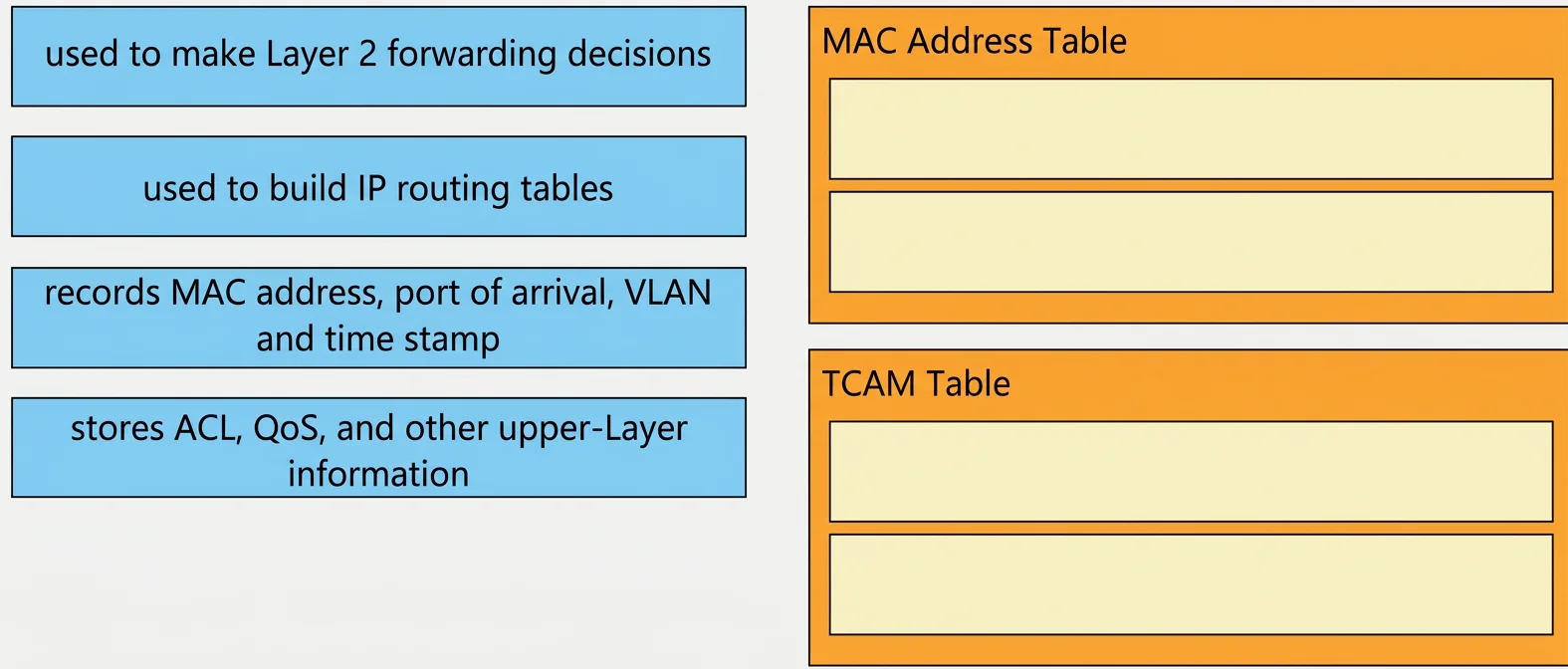
Drag and Drop Question Drag and drop the characteristics from the left to the table types on the right. Answer:
The correct answer is used to make Layer 2 forwarding decisions; records MAC address, port of arrival, VLAN and time stamp; used to build IP routing tables; stores ACL, QoS, and other upper-Layer information. Network switches use three primary tables: the MAC Address Table (CAM table) handles Layer 2 forwarding decisions and records MAC addresses with their port of arrival, VLAN, and timestamp; the Routing Table (built via protocols like OSPF/BGP) is used to make IP routing…
Question
Drag and Drop Question Drag and drop the characteristics from the left to the table types on the right. Answer:
Exhibit
Answer Area
Drag items
Correct arrangement
- used to make Layer 2 forwarding decisions
- records MAC address, port of arrival, VLAN and time stamp
- used to build IP routing tables
- stores ACL, QoS, and other upper-Layer information
Explanation
Network switches use three primary tables: the MAC Address Table (CAM table) handles Layer 2 forwarding decisions and records MAC addresses with their port of arrival, VLAN, and timestamp; the Routing Table (built via protocols like OSPF/BGP) is used to make IP routing decisions; and the TCAM (Ternary Content Addressable Memory) table stores ACL, QoS, and other upper-layer policy information for hardware-accelerated lookups. Each table serves a distinct function in the switching/routing architecture - CAM for L2 switching, RIB/FIB for L3 routing, and TCAM for policy enforcement - and confusing their roles is a common exam trap.
Topics
Community Discussion
No community discussion yet for this question.