
350-401 · Question #639
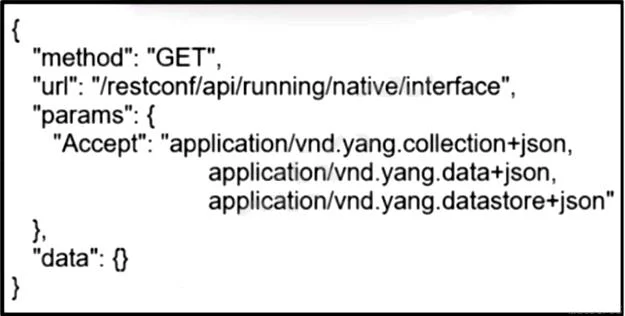
Refer to the exhibit. What is the result of the API request?
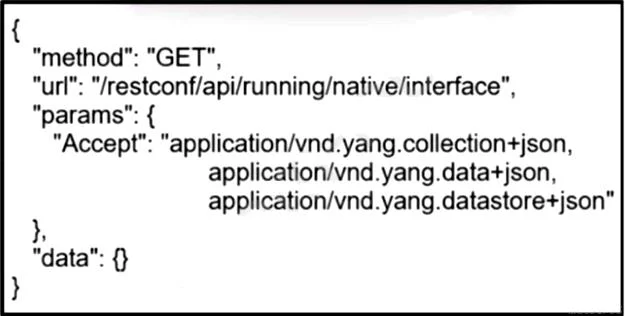
The correct answer is C. The Information for all interfaces is read from the network appliance. The question describes an API request and asks for its result, typically referring to a GET request for a collection of resources.
Question
Refer to the exhibit. What is the result of the API request?
Exhibits
Options
- AThe "params" variable sends data fields to the network appliance.
- BThe native interface information is read from the network appliance.
- CThe Information for all interfaces is read from the network appliance.
- DThe "params" variable reads data fields from the network appliance
How the community answered
(40 responses)- B3% (1)
- C95% (38)
- D3% (1)
Why each option
The question describes an API request and asks for its result, typically referring to a GET request for a collection of resources.
The `params` variable in a GET request is typically used to filter or specify what data to *read* (query parameters), not to *send* data fields for creation or modification.
If the request was to read "native interface information," the endpoint or parameters would likely be more specific (e.g., `/interfaces?type=native`).
Assuming a standard REST API convention where an API request targeting an endpoint like `/interfaces` without specific identifiers or parameters is a GET request, its purpose is to retrieve a collection of resources, thus reading information for all interfaces from the network appliance.
The `params` variable is used to *send* parameters *with* the request, which then helps *read* or filter data *from* the network appliance; the phrasing implies the variable itself reads data, which is technically inaccurate.
Concept tested: REST API GET request interpretation
Topics
Community Discussion
No community discussion yet for this question.