
350-401 · Question #520
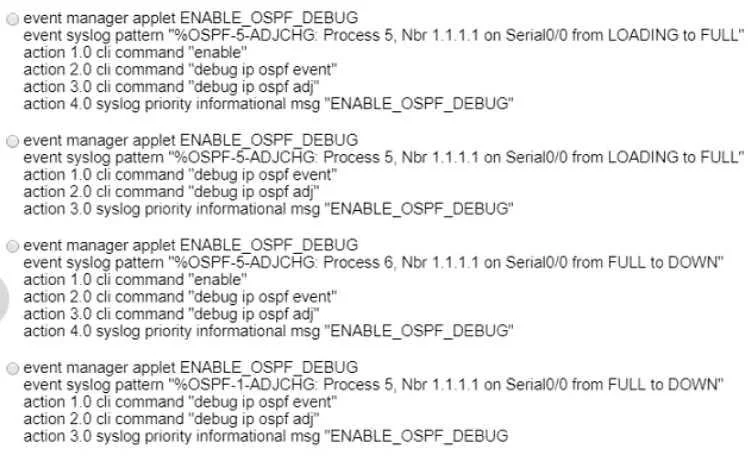
An engineer must create an EEM script to enable OSPF debugging in the event the OSPF neighborship goes down. Which script must the engineer apply?
The correct answer is C. Option C. An EEM script for OSPF debugging requires an event trigger for a neighbor state change to 'DOWN' via syslog, followed by an action to enable OSPF adjacency debugging.
Question
Exhibits
Options
- AOption A
- BOption B
- COption C
- DOption D
How the community answered
(22 responses)- A9% (2)
- B5% (1)
- C86% (19)
Why each option
An EEM script for OSPF debugging requires an event trigger for a neighbor state change to 'DOWN' via syslog, followed by an action to enable OSPF adjacency debugging.
Without the actual content, this option is incorrect as it would likely lack the precise syslog event detection or the correct debugging action for OSPF adjacency issues.
This option is incorrect as it probably contains an inappropriate event trigger or an unrelated action that would not address the OSPF neighborship down scenario with debugging.
The correct EEM script for this scenario would typically utilize an `event syslog` statement with a regular expression pattern that specifically matches the OSPF neighbor state transition to 'DOWN'. Once this syslog event is detected, the script would then execute a `action cli command` to enable `debug ip ospf adjacency`, providing diagnostic information for the failed neighborship.
This option is incorrect as it would not contain the specific EEM commands to detect an OSPF neighbor down event via syslog and enable the relevant `debug ip ospf adjacency` command.
Concept tested: EEM for OSPF neighbor troubleshooting
Source: https://www.cisco.com/c/en/us/td/docs/ios-xml/ios/eem/configuration/15-mt/eem-15-mt-book.html
Topics
Community Discussion
No community discussion yet for this question.