
350-401 · Question #464
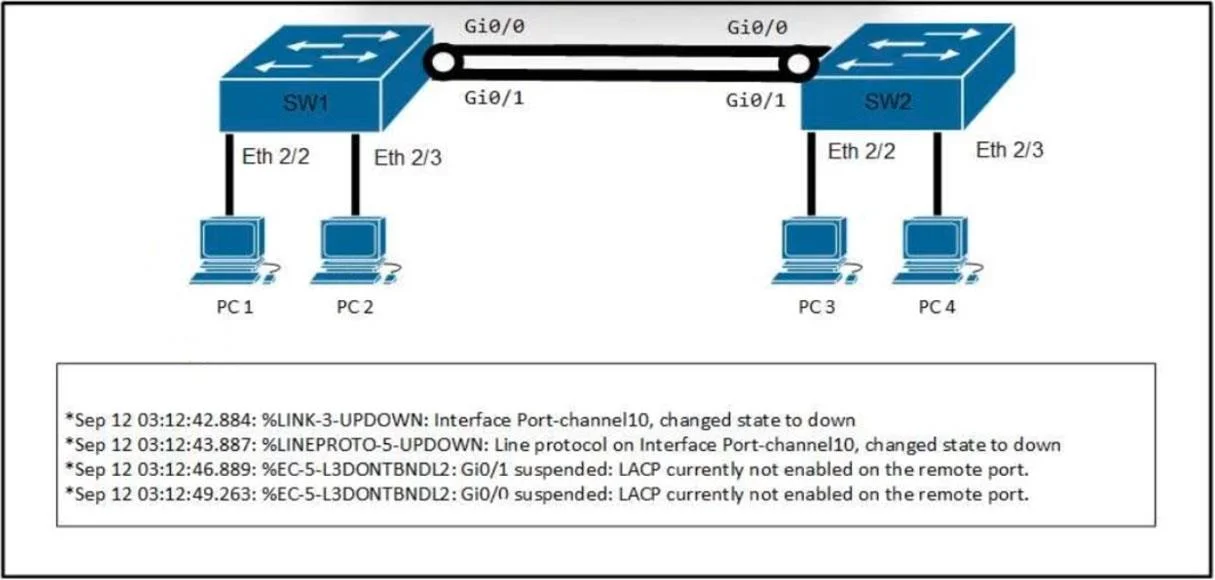
Refer to the exhibit. A network engineer troubleshoots an issue with the port channel between SW1 and SW2. Which command resolves the issue?
The correct answer is B. SW1(config-if)#channel-group 10 mode active. The exhibit indicates SW2 is configured for LACP passive mode, which means it waits for an active LACP peer. To form a port channel, SW1 must be configured for LACP active mode.
Question
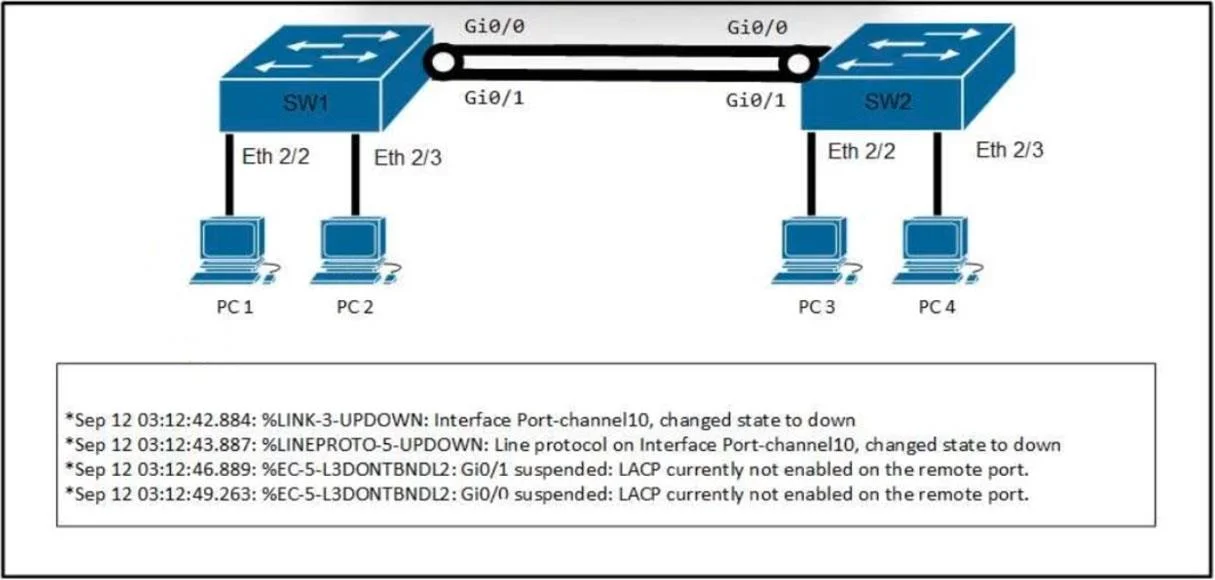
Refer to the exhibit. A network engineer troubleshoots an issue with the port channel between SW1 and SW2. Which command resolves the issue?
Exhibits
Options
- ASW2(config-if)#switchport mode trunk
- BSW1(config-if)#channel-group 10 mode active
- CSW1(config-if)#channel-group 10 mode desirable
- DSW2(config-if)#channel-group 10 mode on
How the community answered
(38 responses)- A13% (5)
- B79% (30)
- C5% (2)
- D3% (1)
Why each option
The exhibit indicates SW2 is configured for LACP `passive` mode, which means it waits for an active LACP peer. To form a port channel, SW1 must be configured for LACP `active` mode.
While `switchport mode trunk` is typically needed for aggregated links, the immediate issue preventing the port channel from forming is the LACP negotiation failure due to mismatched LACP modes.
SW2 is configured with `channel-group 10 mode passive` for LACP, meaning it will listen for LACP packets but not initiate them. For the port channel to form, SW1 must be configured with `channel-group 10 mode active` to actively send LACP packets and negotiate the bundle, satisfying the `passive` peer.
Configuring SW1 to `desirable` mode uses PAgP, not LACP; since SW2 is configured for LACP `passive`, the protocols would not match, and the port channel would not form.
Configuring SW2 to `on` mode puts it into an unconditional EtherChannel, which requires the peer to also be in `on` mode; this would not work with SW1 in LACP `active` or `desirable`.
Concept tested: LACP port channel negotiation modes
Source: https://www.cisco.com/c/en/us/td/docs/switches/lan/catalyst3750/software/release/12-2_55_se/configuration/guide/scg3750/swethchl.html
Topics
Community Discussion
No community discussion yet for this question.