
350-401 · Question #447
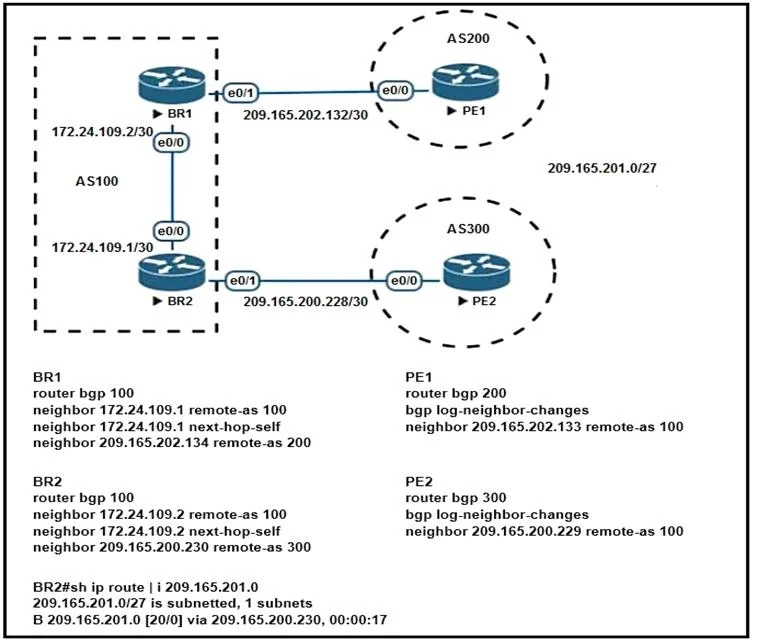
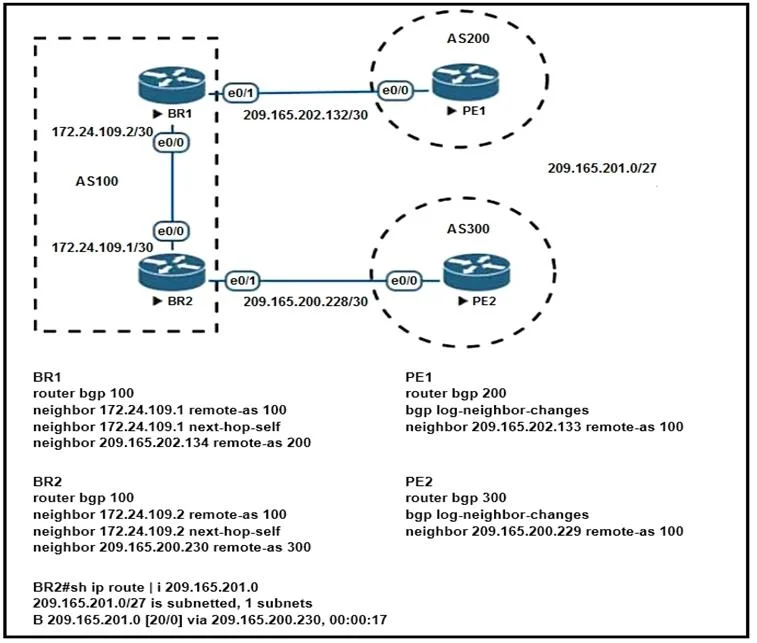
Refer to the exhibit. Which configuration change will force BR2 to reach 209.165.201.0/27 via BR1?
The correct answer is C. Set the MED to 1 on PE2 toward BR2 outbound. To influence BR2's path selection to prefer BR1, the Multi-Exit Discriminator (MED) attribute can be manipulated on the PE2 router advertising routes to BR2.
Question
Refer to the exhibit. Which configuration change will force BR2 to reach 209.165.201.0/27 via BR1?
Exhibits
Options
- ASet the weight attribute to 65,535 on BR1 toward PE1.
- BSet the local preference to 150 on PE1 toward BR1 outbound
- CSet the MED to 1 on PE2 toward BR2 outbound.
- DSet the origin to igp on BR2 toward PE2 inbound.
How the community answered
(44 responses)- A7% (3)
- B23% (10)
- C57% (25)
- D14% (6)
Why each option
To influence BR2's path selection to prefer BR1, the Multi-Exit Discriminator (MED) attribute can be manipulated on the PE2 router advertising routes to BR2.
Weight is a Cisco-specific, local BGP attribute that affects only the router on which it's configured, not how other BGP peers (like BR2) perceive the route.
Local preference is an IGP-wide BGP attribute that influences a router's outbound path selection, but setting it on PE1 toward BR1 outbound would affect PE1's preference, not directly force BR2's inbound path selection.
Setting a lower MED (e.g., 1) on PE2 for routes advertised towards BR2 (outbound) will make that path less preferred by BR2 according to the BGP path selection process, which prefers paths with a lower MED, thereby encouraging BR2 to use the path via BR1.
The origin code is a BGP attribute that affects path selection (IGP is preferred over EGP), but manipulating it on BR2 toward PE2 inbound is less direct and potent than MED for influencing external path preference to a specific route.
Concept tested: BGP path selection (MED attribute)
Source: https://www.cisco.com/c/en/us/support/docs/ip/border-gateway-protocol-bgp/13753-25.html
Topics
Community Discussion
No community discussion yet for this question.