
350-401 · Question #232
What would be the preferred way to implement a loopless switch network where there are 1500 defined VLANs and it is necessary to load the shared traffic through two main aggregation points based on…
The correct answer is B. 802.1s. Explanation 802.1s (Multiple Spanning Tree Protocol - MSTP) is the correct choice because it allows administrators to map multiple VLANs to a smaller number of spanning tree instances, enabling traffic load balancing across two aggregation points based on VLAN ID - for example…
Question
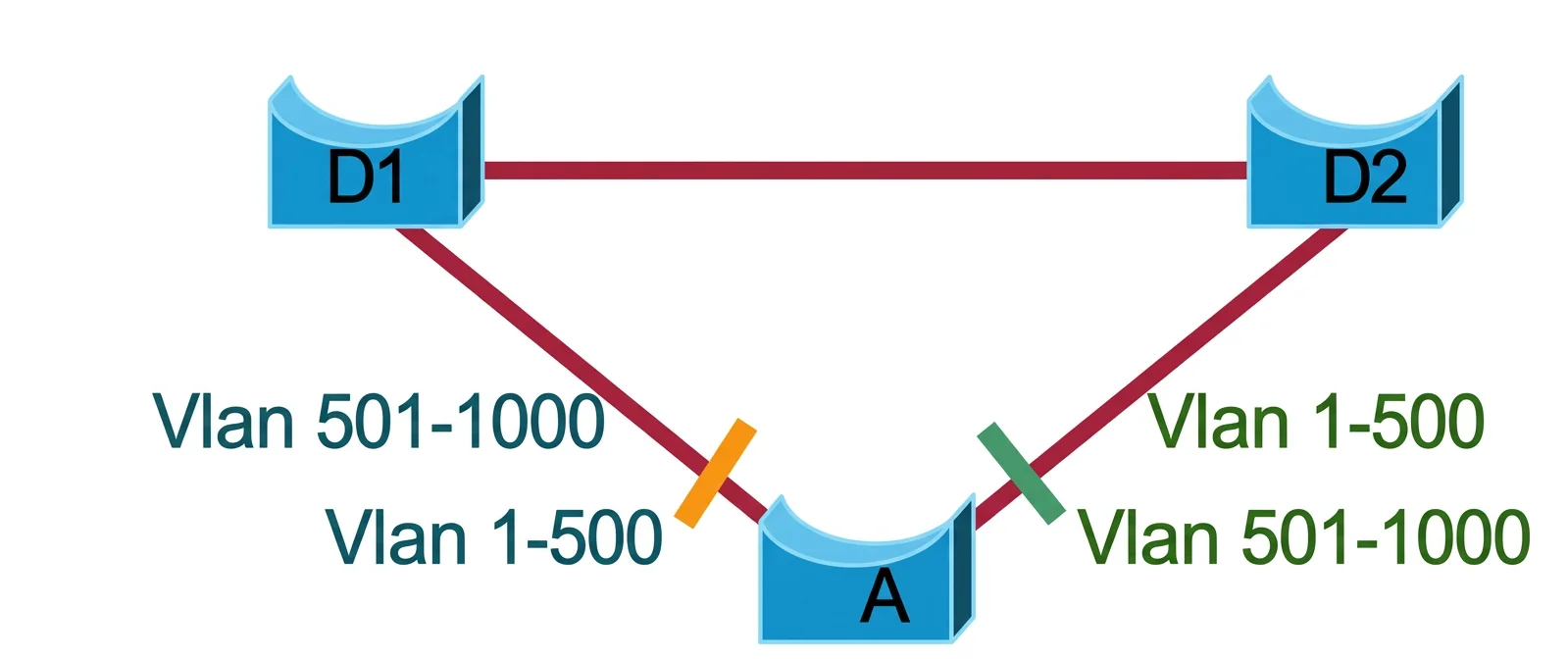
What would be the preferred way to implement a loopless switch network where there are 1500 defined VLANs and it is necessary to load the shared traffic through two main aggregation points based on the VLAN identifier?
Exhibit
Options
- A802.1D
- B802.1s
- C802.1W
- D802.1AE
How the community answered
(27 responses)- A7% (2)
- B78% (21)
- C4% (1)
- D11% (3)
Explanation
Explanation
802.1s (Multiple Spanning Tree Protocol - MSTP) is the correct choice because it allows administrators to map multiple VLANs to a smaller number of spanning tree instances, enabling traffic load balancing across two aggregation points based on VLAN ID - for example, odd-numbered VLANs use one uplink path and even-numbered VLANs use the other, all while maintaining a loop-free topology across all 1500 VLANs.
802.1D (Classic STP) is wrong because it creates a single spanning tree for all VLANs, meaning all traffic uses one path with no load sharing capability. 802.1W (Rapid STP/RSTP) is wrong because, while it improves convergence speed over 802.1D, it still operates as a single spanning tree instance with no VLAN-based load balancing. 802.1AE (MACsec) is completely unrelated - it is a Layer 2 security standard for encrypting Ethernet frames, not a spanning tree protocol.
Memory Tip: Think of the "s" in 802.1s as standing for "several instances" - MSTP lets you create multiple spanning tree instances to share the load, making it the only option that solves both the loop-free and load-balancing requirements simultaneously.
Topics
Community Discussion
No community discussion yet for this question.