
350-401 · Question #1269
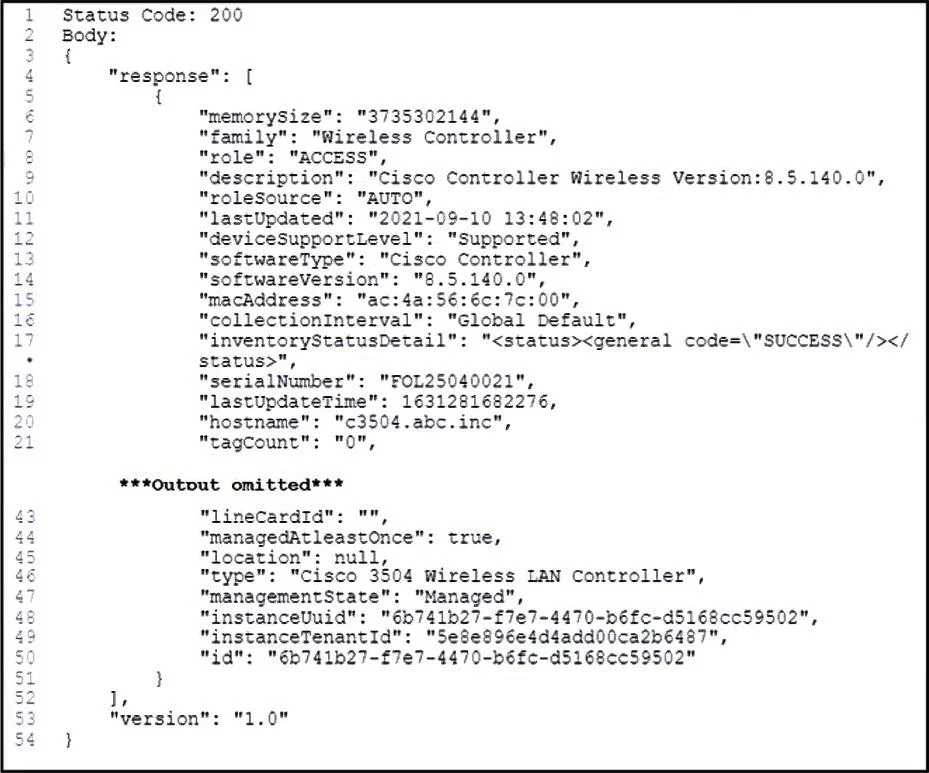
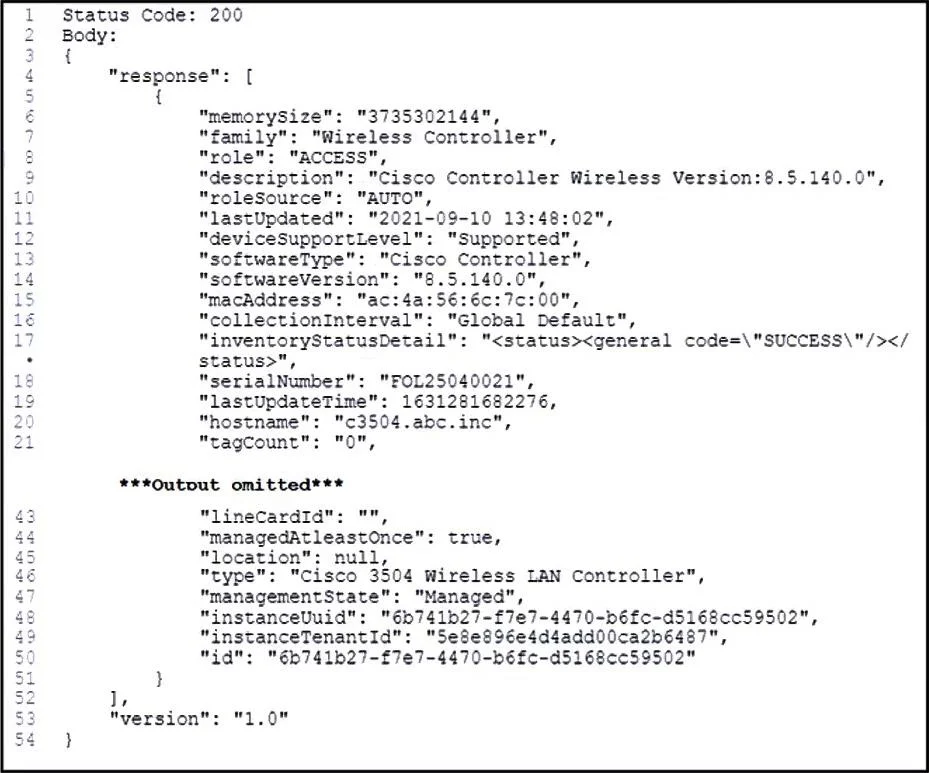
Refer to the exhibit. Which HTTP request produced the REST API response that was returned by Cisco DNA Center?
The correct answer is B. GET /network-device?macAddress=ac:4a:56:6c:7c:00. The provided JSON response shows data being retrieved about a network device, indicating that a GET request was used to query the Cisco DNA Center API.
Question
Refer to the exhibit. Which HTTP request produced the REST API response that was returned by Cisco DNA Center?
Exhibits
Options
- APUT /network-device?macAddress=ac:4a:56:6c:7c:00
- BGET /network-device?macAddress=ac:4a:56:6c:7c:00
- Cfetch /network-device?macAddress=ac:4a:56:6c:7c:00
- DPOST /network-device?macAddress=ac:4a:56:6c:7c:00
How the community answered
(24 responses)- A13% (3)
- B79% (19)
- C4% (1)
- D4% (1)
Why each option
The provided JSON response shows data being retrieved about a network device, indicating that a GET request was used to query the Cisco DNA Center API.
PUT requests are typically used to update an existing resource or create one if it doesn't exist, which would usually return a status indicating the modification, not a list of device properties.
RESTful APIs use the HTTP GET method to retrieve data from a server. The exhibit shows a JSON response containing device details, which is characteristic of a data retrieval operation initiated by a GET request to the `/network-device` endpoint, filtered by a query parameter.
"fetch" is not a standard HTTP method in RESTful APIs; GET is the standard method for retrieving resources.
POST requests are used to create new resources on the server, and the response would typically be an identifier for the newly created resource or a confirmation of creation, not details of an existing device.
Concept tested: REST API HTTP methods (GET)
Source: https://developer.cisco.com/docs/dna-center/#!rest-apis
Topics
Community Discussion
No community discussion yet for this question.