
350-401 · Question #1129
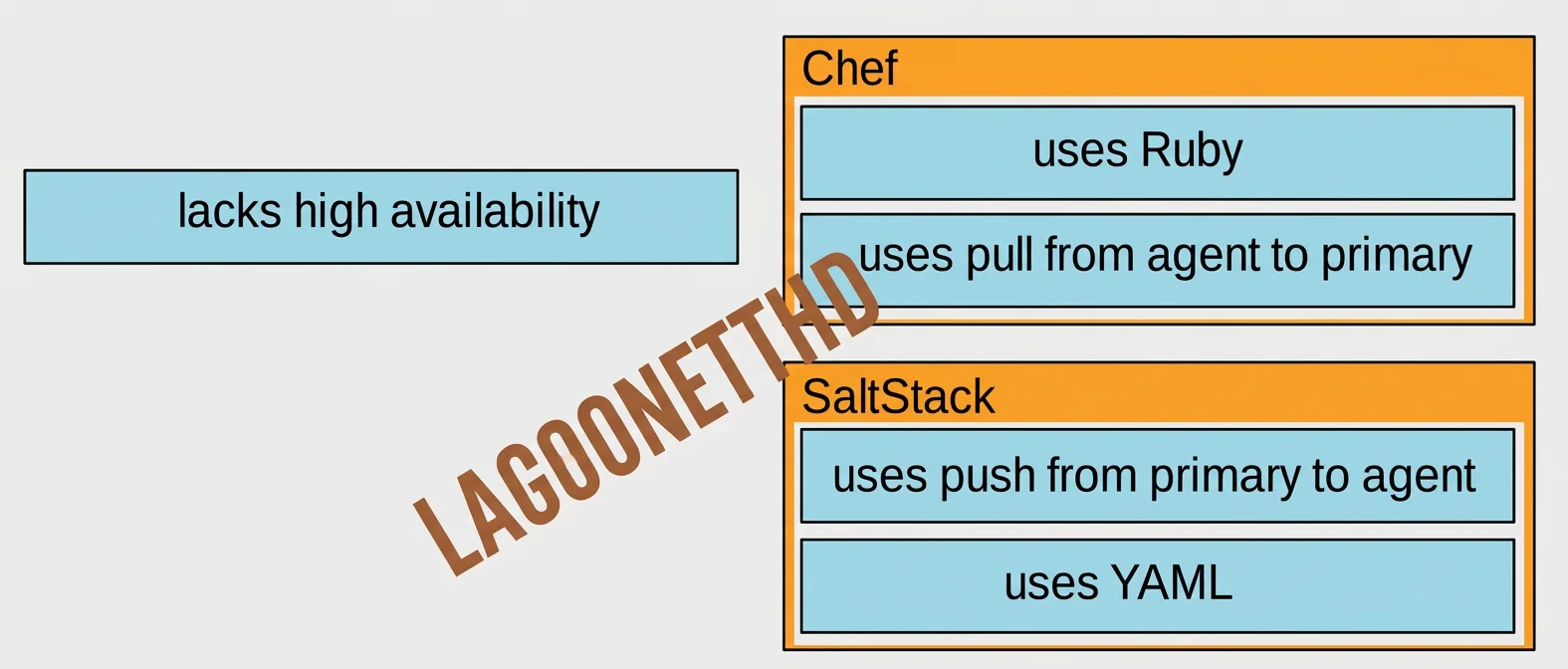
Drag and Drop Question Drag and drop the automation characteristics from the left onto the appropriate tools on the right. Not all options are used Answer:
The correct answer is uses Ruby; lacks high availability; uses pull from agent to primary; uses push from primary to agent; uses YAML. Explanation: Automation Tool Characteristics This question is incomplete as presented - the right-side tool names are missing from the prompt. However, based on the characteristics listed, this is a classic exam question comparing Puppet and Ansible (common on CompTIA, RHCE, or…
Question
Exhibit
Answer Area
Drag items
Correct arrangement
- uses Ruby
- lacks high availability
- uses pull from agent to primary
- uses push from primary to agent
- uses YAML
Explanation
Explanation: Automation Tool Characteristics
This question is incomplete as presented - the right-side tool names are missing from the prompt. However, based on the characteristics listed, this is a classic exam question comparing Puppet and Ansible (common on CompTIA, RHCE, or similar exams). Here's how the items map:
The Two-Tool Context
| Tool | Characteristics |
|---|---|
| Puppet | uses Ruby - uses pull from agent to primary |
| Ansible | uses YAML - uses push from primary to agent - lacks high availability |
Item-by-Item Breakdown
1. "uses Ruby" -> Puppet Puppet's DSL (Domain Specific Language) and its manifest files are written in Ruby. This is a defining characteristic. Chef also uses Ruby, but in most exam contexts contrasting Puppet vs. Ansible, this maps to Puppet.
2. "lacks high availability" -> Ansible Ansible is agentless - it connects over SSH/WinRM on demand with no persistent daemon running on managed nodes. Because there's no resident agent maintaining state, there's no built-in HA mechanism at the node level. This is a known trade-off.
3. "uses pull from agent to primary" -> Puppet Puppet uses a pull model: the Puppet agent on each node periodically contacts the Puppet master and pulls its configuration catalog. The agent initiates the connection.
4. "uses push from primary to agent" -> Ansible Ansible uses a push model: the control node initiates the connection and pushes playbook tasks out to target nodes via SSH. There is no agent waiting to receive.
5. "uses YAML" -> Ansible Ansible playbooks are written in YAML. This is one of Ansible's most recognized traits and a frequent exam target.
Common Misconceptions
- "Both use Ruby" - Puppet uses Ruby; Ansible uses YAML. Don't confuse them.
- "Pull = less secure" - Not necessarily true; pull just means the agent initiates, which can actually reduce attack surface.
- "Ansible lacks HA = it's inferior" - Not a quality judgment; it's a trade-off for simplicity and agentless design.
- "Push means the agent receives passively" - In Ansible, there is no agent. The target just has SSH open.
Topics
Community Discussion
No community discussion yet for this question.