
350-401 · Question #1125
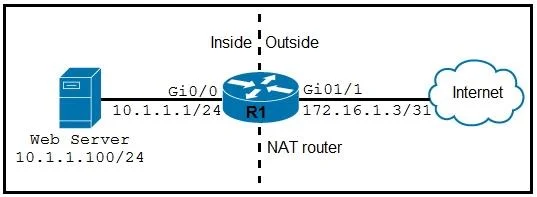
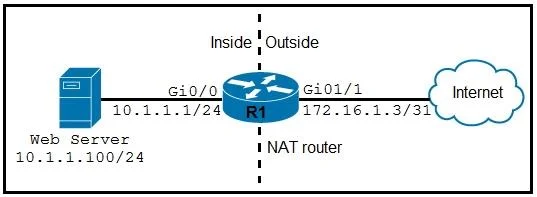
Refer to the exhibit. The web server is configured to listen only to TCP port 8080 for all HTTP requests. Which command is required to allow Internet users to access the web server on HTTP port 80?
The correct answer is C. ip nat inside static tcp 10.1.1.100 8080 10.1.1.100 80. To allow external users to access an internal web server on a different port (80) than it listens on internally (8080), a static NAT with port translation must be configured, mapping the global port 80 to the internal port 8080 for the server.
Question
Refer to the exhibit. The web server is configured to listen only to TCP port 8080 for all HTTP requests. Which command is required to allow Internet users to access the web server on HTTP port 80?
Exhibits
Options
- Aip nat outside static tcp 10.1.1.100 8080 10.1.1.100 80
- Bip nat inside static tcp 10.1.1.100 80 10.1.1.100 8080
- Cip nat inside static tcp 10.1.1.100 8080 10.1.1.100 80
- Dip nat outside static tcp 10.1.1.100 80 10.1.1.100 8080
How the community answered
(26 responses)- A12% (3)
- B8% (2)
- C77% (20)
- D4% (1)
Why each option
To allow external users to access an internal web server on a different port (80) than it listens on internally (8080), a static NAT with port translation must be configured, mapping the global port 80 to the internal port 8080 for the server.
The `ip nat outside static` command is incorrectly used here, and the port mapping order is inverted from what's needed for inbound access to an internal server.
This command reverses the local and global port numbers, meaning it would try to translate requests on internal port 80 to external port 8080, which is not the desired translation for internet users accessing port 80.
The command `ip nat inside static tcp 10.1.1.100 8080 10.1.1.100 80` correctly configures a static NAT with port translation, mapping incoming requests on the external IP `10.1.1.100` and port `80` to the internal web server `10.1.1.100` listening on port `8080`.
Similar to choice A, using `ip nat outside static` is incorrect for this scenario where the internal server needs to be accessible from the outside via NAT configured on an inside interface.
Concept tested: Static NAT with port address translation (PAT)
Source: https://www.cisco.com/c/en/us/td/docs/ios/ipaddr/configuration/guide/12_4t/ip_addr_c/iadc_nat.html
Topics
Community Discussion
No community discussion yet for this question.