
350-201 · Question #68
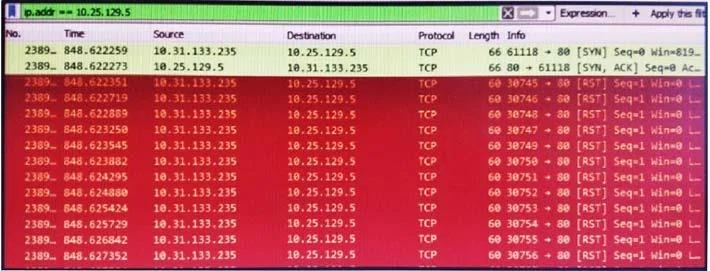
Refer to the exhibit. What is occurring in this packet capture?
The correct answer is B. TCP flood. A TCP flood is a volumetric denial-of-service attack that overwhelms a target by sending a massive number of TCP packets, exhausting its resources.
Question
Refer to the exhibit. What is occurring in this packet capture?
Exhibit
Options
- ATCP port scan
- BTCP flood
- CDNS flood
- DDNS tunneling
How the community answered
(45 responses)- A9% (4)
- B84% (38)
- C2% (1)
- D4% (2)
Why each option
A TCP flood is a volumetric denial-of-service attack that overwhelms a target by sending a massive number of TCP packets, exhausting its resources.
A TCP port scan shows low-volume, sequential SYN packets targeting incrementally increasing destination port numbers to enumerate open services, not a flood of packets to a single port.
The packet capture shows an extremely high volume of TCP packets directed at a single destination in a short time window, which is the hallmark signature of a TCP flood attack. Unlike a port scan, the destination port remains constant, and unlike legitimate traffic, there is no corresponding application-layer exchange - the goal is resource exhaustion on the target host or network device.
A DNS flood uses high-volume UDP packets destined for port 53 to overwhelm a DNS resolver, which would not appear as TCP traffic in a packet capture.
DNS tunneling encodes data inside DNS query and response payloads, producing anomalously large or frequent DNS messages over UDP port 53, not a pattern of TCP flooding.
Concept tested: Identifying TCP flood DoS attacks in packet captures
Source: https://www.cisco.com/c/en/us/td/docs/security/firepower/620/configuration/guide/fpmc-config-guide-v62/dos_protection.html
Topics
Community Discussion
No community discussion yet for this question.