
350-201 · Question #1
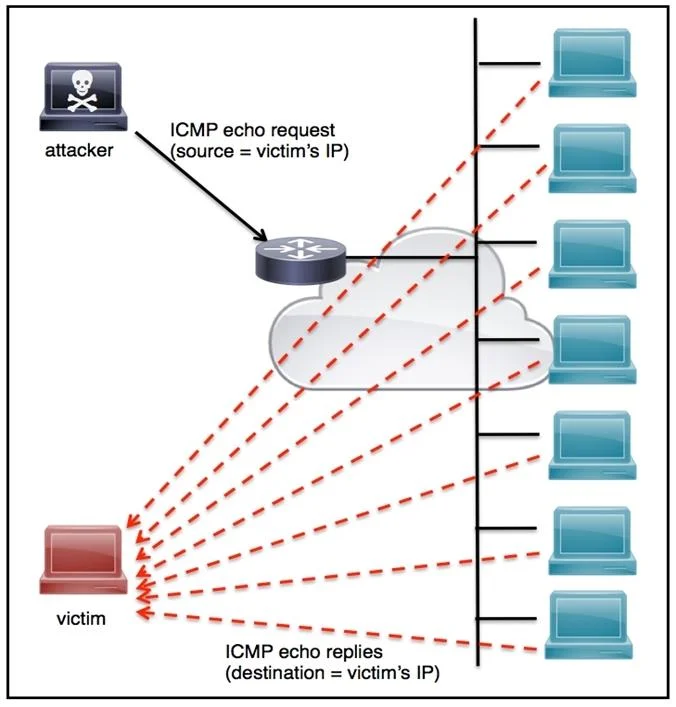
Refer to the exhibit. An engineer must tune the Cisco IOS device to mitigate an attack that is broadcasting a large number of ICMP packets. The attack is sending the victim's spoofed source IP to a…
The correct answer is A. Use command ip verify reverse-path interface. The described attack is a Smurf attack using ICMP with spoofed source IPs directed at broadcast addresses. Enabling uRPF on the interface mitigates this by dropping packets whose source IP cannot be validated against the routing table.
Question
Refer to the exhibit. An engineer must tune the Cisco IOS device to mitigate an attack that is broadcasting a large number of ICMP packets. The attack is sending the victim's spoofed source IP to a network using an IP broadcast address that causes devices in the network to respond back to the source IP address. Which action does the engineer recommend?
Exhibit
Options
- AUse command ip verify reverse-path interface
- BUse global configuration command service tcp-keepalives-out
- CUse subinterface command no ip directed-broadcast
- DUse logging trap 6
How the community answered
(37 responses)- A78% (29)
- B11% (4)
- C8% (3)
- D3% (1)
Why each option
The described attack is a Smurf attack using ICMP with spoofed source IPs directed at broadcast addresses. Enabling uRPF on the interface mitigates this by dropping packets whose source IP cannot be validated against the routing table.
The command 'ip verify reverse-path interface' enables Unicast Reverse Path Forwarding (uRPF), which checks that the source IP of each incoming packet is reachable via the interface it arrived on. Because the attacker uses the victim's spoofed IP as the source, uRPF drops these packets at ingress since the spoofed address is not reachable on that interface, directly neutralizing the amplification vector.
The 'service tcp-keepalives-out' command manages TCP session keepalive behavior and has no mechanism to filter or drop ICMP-based spoofed traffic used in a Smurf attack.
While 'no ip directed-broadcast' stops the router from forwarding directed broadcasts and can prevent the local network from acting as an amplifier, it does not address IP source spoofing and does not drop the forged packets before they traverse the upstream network.
'logging trap 6' sets the syslog severity threshold to informational and only affects which log messages are sent - it does not inspect, filter, or block any attack traffic.
Concept tested: Unicast Reverse Path Forwarding to mitigate IP spoofing
Source: https://www.cisco.com/c/en/us/td/docs/ios-xml/ios/ipaddr/configuration/15-s/iad-15-s-book/iad-urpf.html
Topics
Community Discussion
No community discussion yet for this question.