
350-201 · Question #11
Refer to the exhibit. An organization is using an internal application for printing documents that requires a separate registration on the website. The application allows format-free user creation…
The correct answer is C. validate the restrictions, def validate_user(username, minlen). https://github.com/google/it-cert-automation- practice/commit/8dba0df489b1023cbf391f787be78fd80e539662
Question
Refer to the exhibit. An organization is using an internal application for printing documents that requires a separate registration on the website. The application allows format-free user creation, and users must match these required conditions to comply with the company's user creation policy:
- minimum length: 3
- usernames can only use letters, numbers, dots, and underscores
- usernames cannot begin with a number
The application administrator has to manually change and track these daily to ensure compliance. An engineer is tasked to implement a script to automate the process according to the company user creation policy. The engineer implemented this piece of code within the application, but users are still able to create format-free usernames. Which change is needed to apply the restrictions?
Exhibit
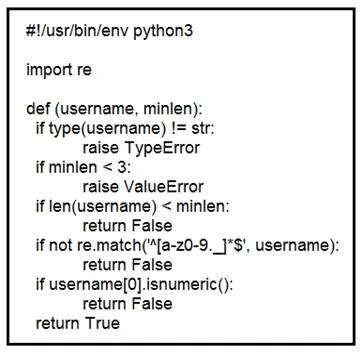
Options
- Amodify code to return error on restrictions def return false_user(username, minlen)
- Bautomate the restrictions def automate_user(username, minlen)
- Cvalidate the restrictions, def validate_user(username, minlen)
- Dmodify code to force the restrictions, def force_user(username, minlen)
How the community answered
(54 responses)- A6% (3)
- B4% (2)
- C78% (42)
- D13% (7)
Explanation
https://github.com/google/it-cert-automation- practice/commit/8dba0df489b1023cbf391f787be78fd80e539662
Topics
Community Discussion
No community discussion yet for this question.