
350-001 · Question #65
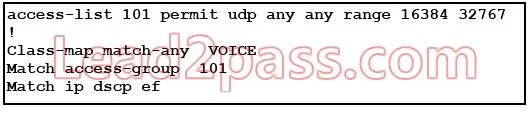
Refer to the exhibit. On what will the config class-map VOICE match?
The correct answer is C. on UDP traffic between port ranges 16384 and 32767, and on DSCP EF traffic. A class-map configured with 'match-any' will match traffic if any one of its match conditions is satisfied, not all of them.
Question
Refer to the exhibit. On what will the config class-map VOICE match?
Exhibit
Options
- Aonly on UDP traffic between port ranges 16384 and 32767
- Bonly on DSCP EF traffic
- Con UDP traffic between port ranges 16384 and 32767, and on DSCP EF traffic
- Donly on EF traffic that is UDP and within the UDP range of 16384 and 32767
How the community answered
(31 responses)- B6% (2)
- C90% (28)
- D3% (1)
Why each option
A class-map configured with 'match-any' will match traffic if any one of its match conditions is satisfied, not all of them.
Matching only on UDP port range would require 'match-all' with only that single criterion, but the class-map also includes a DSCP EF match under 'match-any'.
Matching only on DSCP EF ignores the UDP port-range match statement that is also present in the class-map.
The class-map VOICE uses 'match-any' semantics, meaning traffic is classified if it satisfies at least one of the defined match criteria. Because two separate match statements exist - one for UDP ports 16384-32767 and one for DSCP EF - any packet meeting either condition is placed into the VOICE class.
A 'match-all' policy would require both conditions simultaneously, but this class-map uses 'match-any', so both conditions are independent.
Concept tested: MQC class-map match-any vs match-all semantics
Source: https://www.cisco.com/c/en/us/td/docs/ios-xml/ios/qos_mqc/configuration/15-mt/qos-mqc-15-mt-book/qos-mqc.html
Topics
Community Discussion
No community discussion yet for this question.