
350-001 · Question #39
Which Statement is true about TCN Propagation?
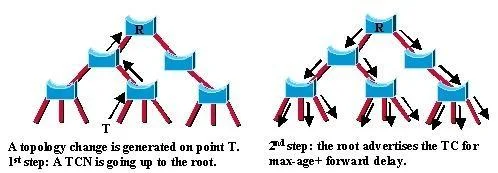
The correct answer is C. A TCN is generated and sent to the root bridge. New Topology Change Mechanisms When an 802.1D bridge detects a topology change, it uses a reliable mechanism to first notify the This is shown in this diagram: Once the root bridge is aware of a change in the topology of the network, it sets the TC flag on the BPDUs it sends…
Question
Which Statement is true about TCN Propagation?
Exhibit
Options
- AThe originator of the TCN immediately floods this information through the network
- Bthe TCN propagation is a two step process
- CA TCN is generated and sent to the root bridge
- Dthe root bridge must flood this information throught the network
How the community answered
(31 responses)- A3% (1)
- B6% (2)
- C87% (27)
- D3% (1)
Explanation
New Topology Change Mechanisms When an 802.1D bridge detects a topology change, it uses a reliable mechanism to first notify the This is shown in this diagram: Once the root bridge is aware of a change in the topology of the network, it sets the TC flag on the BPDUs it sends out, which are then relayed to all the bridges in the network. When a bridge receives a BPDU with the TC flag bit set, it reduces its bridging-table aging time to forward delay seconds. This ensures a relatively quick flush of stale information. Refer to Understanding Spanning-Tree Protocol Topology Changes for more information on this process. This topology change mechanism is deeply remodeled in RSTP. Both the detection of a topology change and its propagation through the network evolve. Topology Change Detection In RSTP, only non-edge ports that move to the forwarding state cause a topology change. This means that a loss of connectivity is not considered as a topology change any more, contrary to 802.1D (that is, a port that moves to blocking no longer generates a TC). When a RSTP bridge detects a topology change, these occur: It starts the TC While timer with a value equal to twice the hello-time for all its non-edge designated ports and its root port, if necessary. It flushes the MAC addresses associated with all these ports. Note: As long as the TC While timer runs on a port, the BPDUs sent out of that port have the TC bit set. BPDUs are also sent on the root port while the timer is active. Topology Change Propagation When a bridge receives a BPDU with the TC bit set from a neighbor, these occur: It clears the MAC addresses learned on all its ports, except the one that receives the topology It starts the TC While timer and sends BPDUs with TC set on all its designated ports and root port (RSTP no longer uses the specific TCN BPDU, unless a legacy bridge needs to be notified). This way, the TCN floods very quickly across the whole network. The TC propagation is now a one step process. In fact, the initiator of the topology change floods this information throughout the network, as opposed to 802.1D where only the root did. This mechanism is much faster than the 802.1D equivalent. There is no need to wait for the root bridge to be notified and then maintain the topology change state for the whole network for <max age plus forward delay> seconds. In just a few seconds, or a small multiple of hello-times, most of the entries in the CAM tables of the entire network (VLAN) flush. This approach results in potentially more temporary flooding, but on the other hand it clears potential stale information that prevents rapid connectivity restitution.
Topics
Community Discussion
No community discussion yet for this question.