
312-38 · Question #63
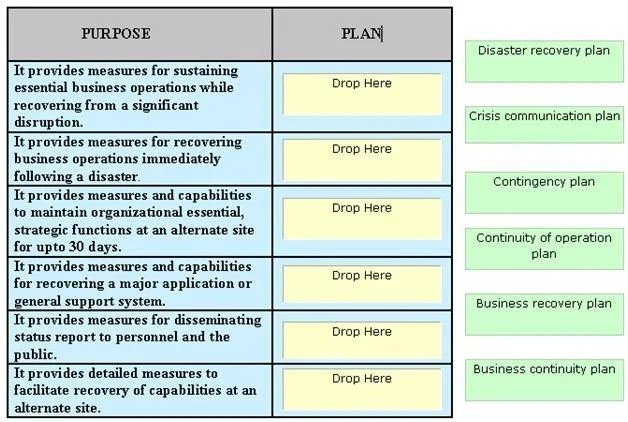
Drag and drop the Response management plans to match up with their respective purposes. Answer:
The correct answer is Business continuity plan; Business recovery plan; Contingency plan; Continuity of operation plan; Crisis communication plan; Disaster recovery plan. Response Management Plans - Drag-and-Drop Explanation The question maps each plan to its specific purpose. Since the purposes aren't shown here, the correct arrangement reflects standard industry definitions. Here's why each plan lands in its position: --- Each Plan Explained…
Question
Exhibit
Answer Area
Drag items
Correct arrangement
- Business continuity plan
- Business recovery plan
- Contingency plan
- Continuity of operation plan
- Crisis communication plan
- Disaster recovery plan
Explanation
Response Management Plans - Drag-and-Drop Explanation
The question maps each plan to its specific purpose. Since the purposes aren't shown here, the correct arrangement reflects standard industry definitions. Here's why each plan lands in its position:
Each Plan Explained
1. Business Continuity Plan (BCP)
Purpose: Ensuring critical business functions continue during a disruption.
The BCP is the broadest, overarching plan. It covers people, processes, and systems holistically. It sits at position 1 because it is the umbrella document - all other plans feed into it.
Common mistake: Confusing BCP with DRP. BCP is about keeping things running; DRP is about recovery after a failure.
2. Business Recovery Plan
Purpose: Restoring normal business operations (non-IT) after a disruption.
This focuses on returning business processes (HR, finance, operations) to normal. It is not IT-focused - that's the DRP's job.
Common mistake: Treating this as identical to BCP. BCP is proactive continuity; Business Recovery is reactive restoration.
3. Contingency Plan
Purpose: Providing alternative procedures when the primary method of operation is unavailable.
This is an "if X fails, do Y" plan. It's procedural and reactive - a fallback for specific scenarios (e.g., a vendor goes down, a system fails).
Common mistake: Confusing contingency with disaster recovery. Contingency plans handle any unexpected deviation, not just large-scale disasters.
4. Continuity of Operations Plan (COOP)
Purpose: Maintaining essential organizational or government functions during an emergency.
COOP is the government/federal agency equivalent of BCP. It specifically addresses mission-critical functions and is a term heavily used in federal/military contexts (FEMA, NIST).
Common mistake: Using COOP and BCP interchangeably. COOP has a narrower, government-centric focus on essential functions only.
5. Crisis Communication Plan
Purpose: Managing internal and external communications during a crisis.
This plan answers: Who do we notify? What do we say publicly? How do we manage media/stakeholders? It does not address technical recovery - it's purely about messaging and information flow.
Common mistake: Overlooking this plan entirely. Communication failure during a crisis can cause as much damage as the crisis itself.
6. Disaster Recovery Plan (DRP)
Purpose: Restoring IT systems, data, and infrastructure after a disaster.
DRP is the most technically specific plan - RTO (Recovery Time Objective), RPO (Recovery Point Objective), backup procedures, and system restoration steps all live here.
Common mistake: Assuming DRP = BCP. DRP is strictly IT-focused and is a subset of the broader BCP.
Quick Reference Summary
| # | Plan | Core Focus |
|---|---|---|
| 1 | Business Continuity Plan | Keep operations running during disruption |
| 2 | Business Recovery Plan | Restore non-IT business operations after disruption |
| 3 | Contingency Plan | Alternative procedures for unexpected failures |
| 4 | Continuity of Operations Plan | Essential functions (government/agency context) |
| 5 | Crisis Communication Plan | Stakeholder and public communications |
| 6 | Disaster Recovery Plan | IT systems and data restoration |
Key Distinction to Remember
Scope hierarchy: BCP > COOP > Business Recovery > DRP > Contingency
Communication is separate: Crisis Communication Plan is orthogonal to all others - it supports every other plan but is its own discipline.
Topics
Community Discussion
No community discussion yet for this question.