
300-820 · Question #110
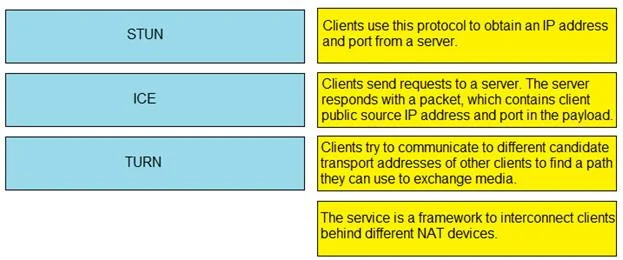
Drag and Drop Question Drag and drop the services from the left onto their descriptions on the right. Some services are used more than once. Answer:
The correct answer is STUN; ICE; TURN; TURN; STUN; ICE. The question assesses knowledge of NAT traversal protocols by requiring the correct matching of STUN and ICE functions to their descriptions related to client address discovery and connection establishment.
Question
Drag and Drop Question Drag and drop the services from the left onto their descriptions on the right. Some services are used more than once. Answer:
Exhibit
Answer Area
Drag items
Correct arrangement
- STUN
- ICE
- TURN
- TURN
- STUN
- ICE
Explanation
The question assesses knowledge of NAT traversal protocols by requiring the correct matching of STUN and ICE functions to their descriptions related to client address discovery and connection establishment.
Approach. To correctly answer the question, each description box on the right must be matched with the most appropriate service from the left.
- 'Clients use this protocol to obtain an IP address and port from a server.' - This describes STUN (Session Traversal Utilities for NAT). STUN's primary purpose is to allow a client behind a NAT to discover its public IP address and the port mapping assigned by the NAT device. Therefore, 'STUN' is the correct match.
- 'Clients send requests to a server. The server responds with a packet, which contains client public source IP address and port in the payload.' - This also describes STUN. It elaborates on the mechanism by which STUN discovers the client's public IP and port by reflecting the client's source information as seen by the STUN server. Therefore, another 'STUN' is the correct match.
- 'Clients try to communicate to different candidate transport addresses of other clients to find a path they can use to exchange media.' - This describes ICE (Interactive Connectivity Establishment). ICE is a framework that gathers various 'candidate' connection possibilities (e.g., direct, via STUN, via TURN relay) and systematically attempts them to find a working communication path between peers, especially for real-time media. Therefore, 'ICE' is the correct match.
- 'The service is a framework to interconnect clients behind different NAT devices.' - This also describes ICE. ICE is the overarching framework that orchestrates STUN and TURN to enable successful peer-to-peer communication, especially when clients are located behind different and complex NAT configurations. Therefore, another 'ICE' is the correct match.
The final mapping is: STUN, STUN, ICE, ICE. This utilizes two STUN instances and two ICE instances, leaving all TURN instances unused, which is permissible as per the question's premise.
Common mistakes.
- common_mistake. A common mistake is to confuse the specific functions of STUN, ICE, and TURN. For instance, incorrectly assigning TURN to descriptions that clearly belong to STUN. TURN's primary role is to act as a relay for traffic when STUN-assisted direct connections fail, not to discover public IP/port information. Another mistake is misidentifying ICE, which is a framework that uses STUN and TURN, with one of the individual protocols. Descriptions referring to a 'framework' or the process of trying 'candidate addresses' are strong indicators for ICE. Failing to recognize that services can be used more than once, or that not all services might be used, could also lead to incorrect choices.
Concept tested. The core concept tested is the understanding of Network Address Translation (NAT) traversal techniques, specifically the distinct roles and interdependencies of STUN (Session Traversal Utilities for NAT), ICE (Interactive Connectivity Establishment), and TURN (Traversal Using Relays around NAT) in establishing communication for real-time applications between clients behind various NAT types.
Topics
Community Discussion
No community discussion yet for this question.