
300-740 · Question #55
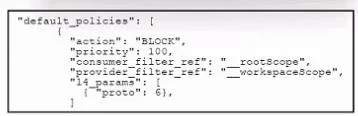
Refer to the exhibit. An engineer configured a default segmentation policy in Cisco Secure Workload to block SMTP traffic. During testing, it is observed that the SMTP traffic is still allowed…
The correct answer is C. Add "port": [25, 25] to _params. In Cisco Secure Workload's default segmentation policy, _params is where traffic-matching parameters - including port ranges - must be defined. Without specifying "port": [25, 25] in _params, the policy engine has no instruction to match SMTP traffic (TCP port 25), so the block…
Question
Refer to the exhibit. An engineer configured a default segmentation policy in Cisco Secure Workload to block SMTP traffic. During testing, it is observed that the SMTP traffic is still allowed. Which action must the engineer take to complete the configuration?
Exhibit
Options
- AAdd "port": [25, 25] to _rootScope
- BAdd _SMTPScope to provider_filter_ref
- CAdd "port": [25, 25] to _params
- DChange consumer_filter_ref to: _SMTPScope
How the community answered
(21 responses)- A5% (1)
- B19% (4)
- C71% (15)
- D5% (1)
Explanation
In Cisco Secure Workload's default segmentation policy, _params is where traffic-matching parameters - including port ranges - must be defined. Without specifying "port": [25, 25] in _params, the policy engine has no instruction to match SMTP traffic (TCP port 25), so the block action is never triggered and traffic passes through.
Why the distractors are wrong:
- A is wrong because
_rootScopedefines the scope boundary (which workloads are included), not the port/protocol parameters for a policy rule. - B is wrong because
provider_filter_refidentifies the destination workload group - changing it alters who receives traffic, not what traffic is matched. - D is wrong because
consumer_filter_refidentifies the source workload group - again, this changes who sends traffic, not which ports are filtered.
Memory tip: Think of _params as the "what" (what traffic to act on - ports/protocols), while consumer_filter_ref and provider_filter_ref are the "who" (source and destination workloads). You must define the "what" in _params before the policy can enforce anything on a specific protocol like SMTP.
Topics
Community Discussion
No community discussion yet for this question.