
300-740 · Question #50
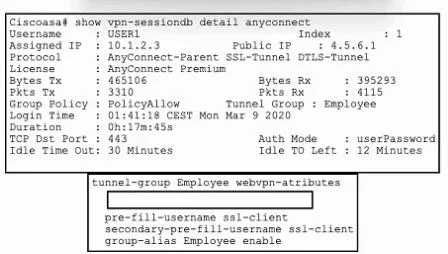
Refer to the exhibit. An engineer must implement a remote access VPN solution that provides user and device verification. The company uses Active Directory for user authentication and ID…
The correct answer is B. webvpn authorize-device. webvpn authorize-device is the correct command because it explicitly enforces device authorization within the WebVPN tunnel-group, requiring a valid device identity certificate before a session is permitted - closing the gap where users could previously connect with credentials…
Question
Refer to the exhibit. An engineer must implement a remote access VPN solution that provides user and device verification. The company uses Active Directory for user authentication and ID certificates for device identity. Users are currently able to connect using only a valid username and password, even if their computer is missing the required certificate. Which command from the Cisco ASA tunnel-group completes the requirement of verifying device identity in addition to user identity?
Exhibit
Options
- Aldap-attribute-map PolicyAllow
- Bwebvpn authorize-device
- Cauthentication mfa
- Dauthentication aaa certificate
How the community answered
(32 responses)- A3% (1)
- B91% (29)
- D6% (2)
Explanation
webvpn authorize-device is the correct command because it explicitly enforces device authorization within the WebVPN tunnel-group, requiring a valid device identity certificate before a session is permitted - closing the gap where users could previously connect with credentials alone. This directly targets the device verification requirement while preserving the existing AD-based user authentication.
Why the distractors are wrong:
- A (
ldap-attribute-map PolicyAllow) - LDAP attribute maps translate Active Directory attributes into ASA group-policy assignments; they control authorization policies, not device certificate verification. - C (
authentication mfa) - MFA adds a second factor to user authentication (e.g., OTP or push notification); it does nothing to verify the device's identity certificate. - D (
authentication aaa certificate) - While this command does combine AAA and certificate requirements, it applies to user certificate authentication, not dedicated device-identity verification. The scenario specifically calls for device identity via ID certificates as a separate check from user credentials.
Memory tip: The word "device" is right in the command - authorize-**device**. On the exam, if the question asks about verifying device identity, look for the word "device" in the answer. Any command scoped to aaa, ldap, or mfa is operating on the user plane, not the device plane.
Topics
Community Discussion
No community discussion yet for this question.