
300-730 · Question #26
Which is used by GETVPN, FlexVPN and DMVPN?
The correct answer is D. ESP. ESP (Encapsulating Security Payload) is the IPsec protocol common to GETVPN, FlexVPN, and DMVPN, providing data encryption and integrity for each technology.
Question
Exhibits
Options
- ANHRP
- BMPLS
- CGRE
- DESP
How the community answered
(33 responses)- A3% (1)
- B3% (1)
- C6% (2)
- D88% (29)
Why each option
ESP (Encapsulating Security Payload) is the IPsec protocol common to GETVPN, FlexVPN, and DMVPN, providing data encryption and integrity for each technology.
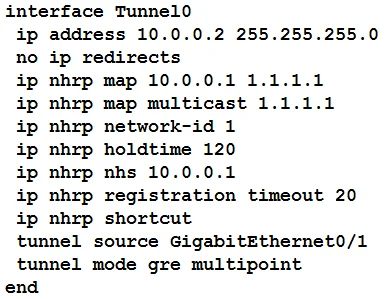
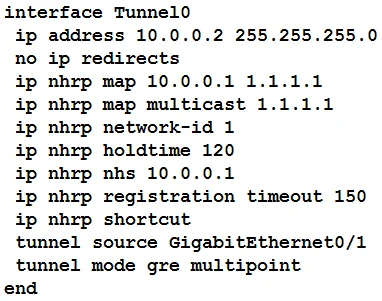
NHRP is used by DMVPN and FlexVPN for dynamic spoke-to-spoke tunnel resolution, but GETVPN does not use NHRP because it relies on a key server and multicast distribution instead.
MPLS is a label-switching forwarding technology used for traffic engineering and is not an inherent component of GETVPN, FlexVPN, or DMVPN.
GRE is used by DMVPN and FlexVPN to encapsulate packets before IPsec encryption, but GETVPN encrypts native routed IP packets directly and does not use GRE tunnels.
ESP is the IPsec encapsulation protocol that encrypts and authenticates packet payloads, and it is the single element shared across all three VPN technologies. GETVPN uses ESP in transport mode to encrypt native IP packets without tunneling, while DMVPN and FlexVPN use ESP within their respective tunnel constructs. No other listed protocol is universally required by all three.
Concept tested: Common IPsec protocol across Cisco VPN technologies
Source: https://www.cisco.com/c/en/us/td/docs/ios-xml/ios/sec_conn_vpnips/configuration/xe-16/sec-ipsec-xe-16-book/sec-cfg-vpn-ipsec.html
Topics
Community Discussion
No community discussion yet for this question.