
300-730 · Question #110
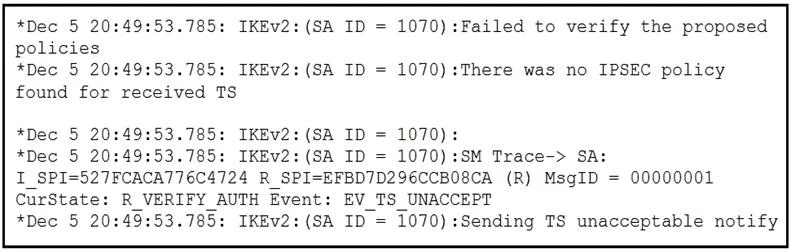
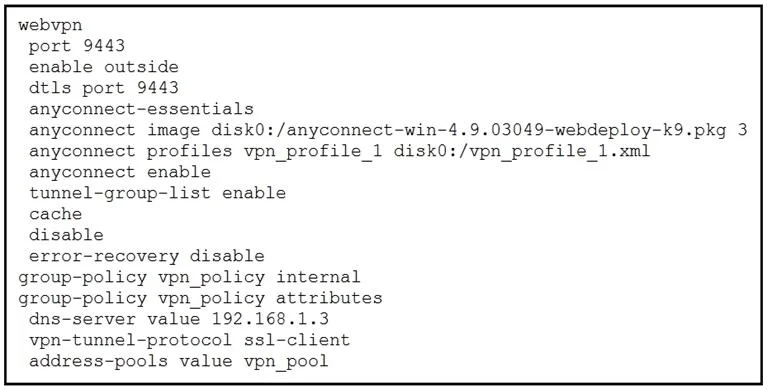
Refer to the exhibit. The debug output of an IKEv2 exchange between two devices is shown. Why is the IKEv2 exchange failing?
The correct answer is D. Add the remote peer's identity to the server's IKEv2 profile. IKEv2 authentication fails when the remote peer's identity is absent from the local IKEv2 profile, preventing the router from matching the incoming IKE_AUTH to a valid policy.
Question
Exhibits
Options
- AAdd the remote peer's IP address to the server's IKEv2 keyring.
- BEnsure that the UDP 500 packets between devices are not dropped.
- CAdd the remote peer's identity to the server's IKEv2 profile.
- DAdd the remote peer's identity to the server's IKEv2 profile.
How the community answered
(65 responses)- A22% (14)
- B6% (4)
- C12% (8)
- D60% (39)
Why each option
IKEv2 authentication fails when the remote peer's identity is absent from the local IKEv2 profile, preventing the router from matching the incoming IKE_AUTH to a valid policy.
The IKEv2 keyring stores pre-shared keys indexed by peer address or hostname, not the peer identities used for profile matching; a missing key would produce a distinct pre-shared-key authentication error rather than the profile-matching failure shown.
If UDP 500 packets were being dropped, no IKE messages would arrive at the device at all and the debug output would show no exchange activity rather than a failure mid-exchange.
Choice C is textually identical to choice D in this question, making it a duplicate entry rather than a distinct incorrect option.
The IKEv2 profile uses identity matching to verify remote peers during the IKE_AUTH exchange. If the remote peer's identity (IP address, FQDN, or email) is not present in the server's IKEv2 profile, the router cannot associate the incoming session with a valid profile and the authentication phase fails. Adding the identity to the profile resolves the mismatch visible in the debug output.
Concept tested: IKEv2 profile peer identity matching configuration
Source: https://www.cisco.com/c/en/us/td/docs/ios-xml/ios/sec_conn_ikevpn/configuration/xe-16/sec-ike-for-ipsec-vpns-xe-16-book/sec-cfg-ikev2-flex.html
Topics
Community Discussion
No community discussion yet for this question.