
300-725 · Question #22
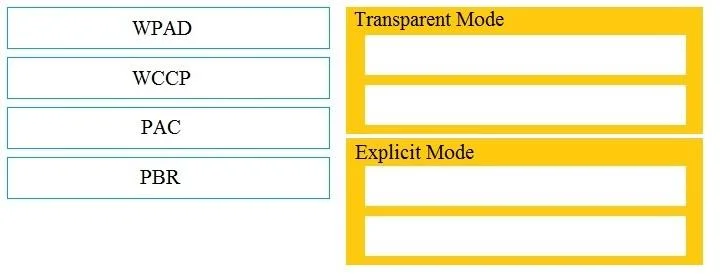
Drag and Drop Question Drag and drop the Cisco WSA methods from the left onto the correct deployment modes on the right. Answer:
The correct answer is WCCP; PBR; PAC; WPAD. This question tests the understanding of Cisco Web Security Appliance (WSA) deployment methods, requiring the categorization of various redirection and configuration techniques into either Transparent Mode or Explicit Mode.
Question
Exhibit
Answer Area
Drag items
Correct arrangement
- WCCP
- PBR
- PAC
- WPAD
Explanation
This question tests the understanding of Cisco Web Security Appliance (WSA) deployment methods, requiring the categorization of various redirection and configuration techniques into either Transparent Mode or Explicit Mode.
Approach. The correct interaction involves dragging 'WCCP' and 'PBR' into the 'Transparent Mode' drop zone, and 'PAC' and 'WPAD' into the 'Explicit Mode' drop zone. This is because:
- Transparent Mode: In this mode, clients are unaware that their traffic is being intercepted and forwarded to a proxy. Network devices like routers or switches redirect client traffic to the WSA. WCCP (Web Cache Communication Protocol) is a Cisco-proprietary protocol used by routers to redirect web traffic to a WSA. PBR (Policy-Based Routing) allows routers to redirect traffic based on defined policies, effectively forcing traffic through the WSA without client-side configuration.
- Explicit Mode: In this mode, clients are explicitly configured to use the WSA as their proxy server. PAC (Proxy Auto-Configuration) files are scripts that browsers use to determine which proxy to use for a given URL. WPAD (Web Proxy Auto-Discovery Protocol) is a method to automatically discover the location of a PAC file, allowing clients to configure themselves explicitly to use the proxy without manual intervention. Both PAC and WPAD result in the client being explicitly configured to send traffic to the proxy.
Common mistakes.
- common_mistake. A common mistake is confusing the nature of WPAD. While WPAD is 'auto-discovery,' it still leads to an explicit proxy configuration on the client's browser, not a transparent redirection. Another mistake would be incorrectly associating WCCP or PBR with explicit modes, which would imply client-side configuration, whereas they are network-level redirection mechanisms. Placing PAC or WPAD under 'Transparent Mode' would be incorrect because these methods require the client's browser to be aware of and configured to use a proxy, even if automatically.
Concept tested. Cisco Web Security Appliance (WSA) deployment modes (Transparent vs. Explicit) and associated redirection/configuration methods (WCCP, PBR, PAC, WPAD). This tests knowledge of how web proxies are integrated into network environments and how clients are directed to use them.
Topics
Community Discussion
No community discussion yet for this question.