
300-720 · Question #79
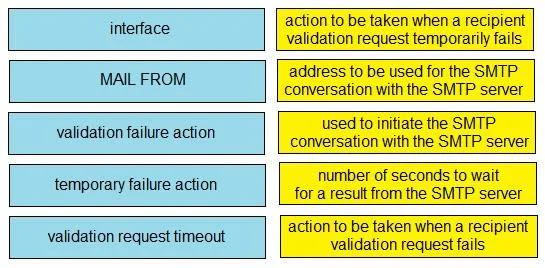
Drag and Drop Question Drag and drop the SMTP Call-Ahead Server Profile Settings from the left onto the descriptions on the right. Answer:
The correct answer is temporary failure action; MAIL FROM; interface; validation request timeout; validation failure action. This drag-and-drop question tests knowledge of SMTP Call-Ahead Server Profile Settings by matching configuration parameters to their functional descriptions.
Question
Drag and Drop Question Drag and drop the SMTP Call-Ahead Server Profile Settings from the left onto the descriptions on the right. Answer:
Exhibit
Answer Area
Drag items
Correct arrangement
- temporary failure action
- MAIL FROM
- interface
- validation request timeout
- validation failure action
Explanation
This drag-and-drop question tests knowledge of SMTP Call-Ahead Server Profile Settings by matching configuration parameters to their functional descriptions.
Approach. The correct interaction involves dragging each blue setting box to its corresponding yellow description box:
- interface should be dragged to 'used to initiate the SMTP conversation with the SMTP server'. The 'interface' specifies which network interface on the security device will be used to connect to the target SMTP server for validation.
- MAIL FROM should be dragged to 'address to be used for the SMTP conversation with the SMTP server'. During an SMTP call-ahead, the security device initiates an SMTP conversation and uses a 'MAIL FROM' command, often with a null sender (<>) or a specific address, to query the recipient's existence.
- validation failure action should be dragged to 'action to be taken when a recipient validation request fails'. This setting defines the action (e.g., reject, drop, accept) if the destination server explicitly indicates the recipient does not exist or another hard failure occurs.
- temporary failure action should be dragged to 'action to be taken when a recipient validation request temporarily fails'. This setting dictates the action if the SMTP server responds with a temporary error (e.g., 4XX code), indicating a transient issue rather than a permanent failure.
- validation request timeout should be dragged to 'number of seconds to wait for a result from the SMTP server'. This parameter sets the maximum time the security device will wait for a response from the destination SMTP server during the call-ahead process.
Common mistakes.
- common_mistake. A common mistake is confusing 'validation failure action' with 'temporary failure action', as both relate to errors but describe different types of failures (permanent vs. transient). Another error might be misinterpreting 'interface' as a command rather than the network port used for outbound validation connections, or incorrectly associating 'MAIL FROM' with the original sender of the email being validated instead of the address used for the call-ahead conversation itself. Forgetting that 'validation request timeout' specifically refers to a time limit for a response can also lead to misplacement.
Concept tested. The core concept tested is SMTP Call-Ahead (also known as Callout Verification or Recipient Validation), an email security feature used to verify the existence of a recipient's email address on the destination mail server before accepting an incoming email. It assesses knowledge of the specific configuration parameters involved in setting up and managing this recipient validation process, including how errors and timeouts are handled.
Topics
Community Discussion
No community discussion yet for this question.