
300-620 · Question #229
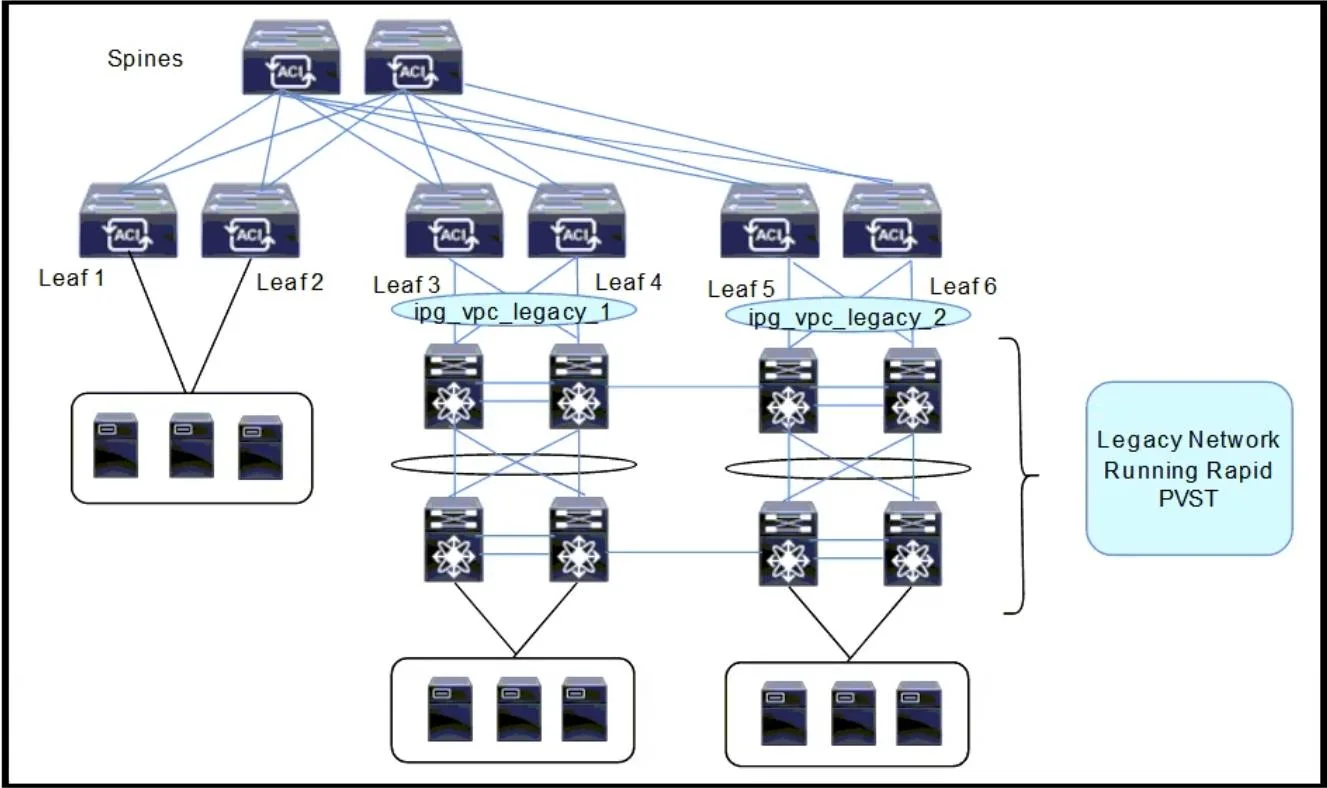
Refer to the exhibit. A client is configuring a new Cisco ACI fabric. All VLANs will be extended during the migration phase using the VPC connections on leaf switches 3, 4 and leaf switches 5, 6…
The correct answer is A. MCP: enabled. MCP detects loops from external sources and will err-disable the interface on which ACI receives its own packet. Enabling this feature is a best practice and it should be enabled globally and on all interfaces, regardless of the end device. MCP works to stop Layer-2 loops, it…
Question
Refer to the exhibit. A client is configuring a new Cisco ACI fabric. All VLANs will be extended during the migration phase using the VPC connections on leaf switches 3, 4 and leaf switches 5, 6 toward the legacy network. The migration phase has these requirements:
- The legacy switches must be able to transfer BPDUs through the ACI
fabric.
- If the legacy switches fail to break a loop, Cisco ACI must break the
loop. Which group settings must be configured on VPC interface policy groups ipg_vpc-legacy_1 and ipg_vpc-legacy_2 to meet these requirements?
Exhibit
Options
- AMCP: enabled
- BMCP: disabled
- CMCP: enabled
- DMCP: disabled
How the community answered
(25 responses)- A80% (20)
- B12% (3)
- C4% (1)
- D4% (1)
Explanation
MCP detects loops from external sources and will err-disable the interface on which ACI receives its own packet. Enabling this feature is a best practice and it should be enabled globally and on all interfaces, regardless of the end device. MCP works to stop Layer-2 loops, it should be enabled right away on an ACI Fabric prior to connecting Layer-2 devices for migration purposes.
Topics
Community Discussion
No community discussion yet for this question.