
300-620 · Question #211
Refer to the exhibit. Which two configurations enable inter-VRF communication? (Choose two.)
The correct answer is A. Set the subnet scope to Shared Between VRFs. D. Change the contract scope to Tenant. To enable inter-VRF communication in Cisco ACI, two key configurations are required: setting the subnet scope to "Shared Between VRFs" and configuring the contract scope to "Tenant" (or Global) for the communication policy.
Question
Refer to the exhibit. Which two configurations enable inter-VRF communication? (Choose two.)
Exhibit
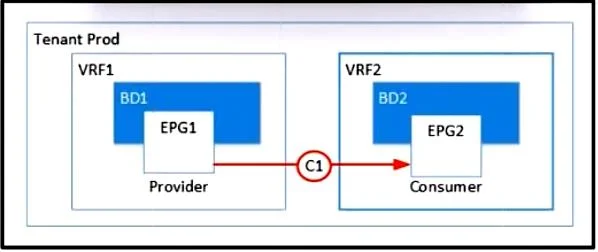
Options
- ASet the subnet scope to Shared Between VRFs.
- BEnable Advertise Externally under the subnet scope.
- CExport the contract and import as a contract interface.
- DChange the contract scope to Tenant.
- EChange the subject scope to VRF.
How the community answered
(26 responses)- A85% (22)
- B4% (1)
- C8% (2)
- E4% (1)
Why each option
To enable inter-VRF communication in Cisco ACI, two key configurations are required: setting the subnet scope to "Shared Between VRFs" and configuring the contract scope to "Tenant" (or Global) for the communication policy.
Setting the subnet scope to "Shared Between VRFs" makes the subnet IP address visible and routable across different VRF instances within the same tenant. This is a prerequisite for endpoints residing in different VRFs to be able to route traffic to each other.
"Advertise Externally" is used for advertising subnets from ACI to external routing devices via an L3Out connection, not for enabling routing directly between VRFs within the ACI fabric.
Exporting and importing a contract as a contract interface is a method for sharing contracts, particularly between tenants or for advanced service graph deployments, but the fundamental configuration for inter-VRF communication relies on the contract's scope and the subnet's scope.
To allow communication between Endpoint Groups (EPGs) that belong to different VRFs, the contract that governs their interaction must have a scope that extends beyond a single VRF. Setting the contract scope to "Tenant" allows any EPG within that tenant, regardless of its associated VRF, to provide or consume the contract, thereby enabling inter-VRF communication.
Changing the subject scope to "VRF" would actually limit the subject to EPGs within a single VRF; to enable inter-VRF communication, the contract scope needs to be broader, such as "Tenant."
Concept tested: ACI Inter-VRF communication setup
Source: https://www.cisco.com/c/en/us/td/docs/dcn/aci/apic/6x/config-guide/cisco-aci-vrf-config-guide-601/m_vrf.html
Topics
Community Discussion
No community discussion yet for this question.