
300-620 · Question #198
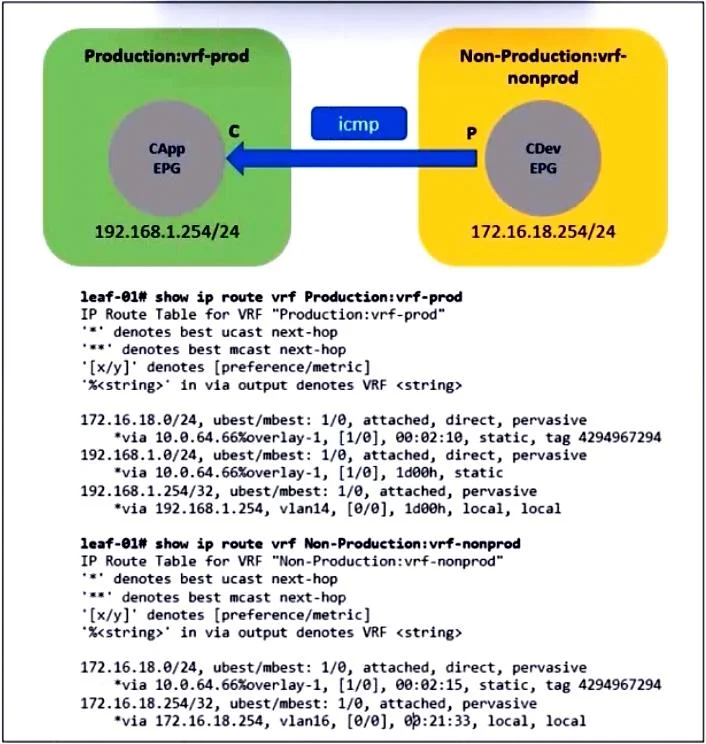
Refer to the exhibit. An administrator configures inter-VRF route leaking between Production:vrf- prod and Non-Production:vrf-nonprod. However, the route in the Non-Production:vrf-nonprod VRF to the…
The correct answer is B. Enable the Shared between VRFs option for the BD subnet in the production VRF. To resolve a missing route for inter-VRF route leaking, the subnet within the bridge domain in the provider VRF (production VRF) must have the "Shared between VRFs" option enabled. This configuration allows the subnet to be advertised and leaked to the consumer VRF…
Question
Refer to the exhibit. An administrator configures inter-VRF route leaking between Production:vrf- prod and Non-Production:vrf-nonprod. However, the route in the Non-Production:vrf-nonprod VRF to the production tenant is missing. Which action resolves the VRF route leaking issue?
Exhibit
Options
- AChange the contract scope to Global.
- BEnable the Shared between VRFs option for the BD subnet in the production VRF.
- CEnable the Shared between VRFs option for the EPG subnet in the non-production VRF.
- DExport the contract from provider to consumer tenant.
How the community answered
(29 responses)- A7% (2)
- B76% (22)
- C3% (1)
- D14% (4)
Why each option
To resolve a missing route for inter-VRF route leaking, the subnet within the bridge domain in the provider VRF (production VRF) must have the "Shared between VRFs" option enabled. This configuration allows the subnet to be advertised and leaked to the consumer VRF (non-production VRF).
Changing the contract scope to Global is typically for inter-tenant communication or making an L3Out globally available, but it does not directly enable the leaking of specific BD subnets between VRFs within the same or different tenants.
For inter-VRF route leaking, the specific subnet within the Bridge Domain (BD) that resides in the source or provider VRF (Production:vrf-prod in this scenario) must be explicitly configured with the "Shared between VRFs" option. This flag enables the ACI fabric to advertise and leak that subnet's route into other VRFs, such as Non-Production:vrf-nonprod, when a contract permits.
Subnets are defined at the Bridge Domain level, not directly at the EPG level, and enabling "Shared between VRFs" on an EPG subnet is not the correct mechanism for inter-VRF route leaking. The flag applies to BD subnets.
Exporting a contract from a provider to a consumer tenant is for inter-tenant contract sharing, not the specific setting required for enabling a subnet to be leaked between VRFs.
Concept tested: Cisco ACI inter-VRF route leaking, shared BD subnets
Source: https://www.cisco.com/c/en/us/td/docs/dcn/aci/apic/5x/config-guide/b_Cisco_APIC_Layer_3_Networking_Configuration_Guide_5x/b_Cisco_APIC_Layer_3_Networking_Configuration_Guide_5x_chapter_0100.html
Topics
Community Discussion
No community discussion yet for this question.