
300-620 · Question #188
Refer to the exhibit. A company merges three of its departments: CORP, HR, and SERVICES, Currently, the connectivity between departments is achieved by using VRF route leaking. The requirement is to…
The correct answer is D. Implement an unenforced VRF in the common tenant and map all required BDs to it. To enable seamless communication between EPGs and BDs across any tenant without explicit contracts or VRF route leaking, a shared, openly communicating VRF is required.
Question
Refer to the exhibit. A company merges three of its departments: CORP, HR, and SERVICES, Currently, the connectivity between departments is achieved by using VRF route leaking. The requirement is to redesign the Cisco ACI networking architecture to communicate between EPGs and BDs from any tenant without configuring contracts or VRF route leaking. Which configuration meets these criteria?
Exhibit
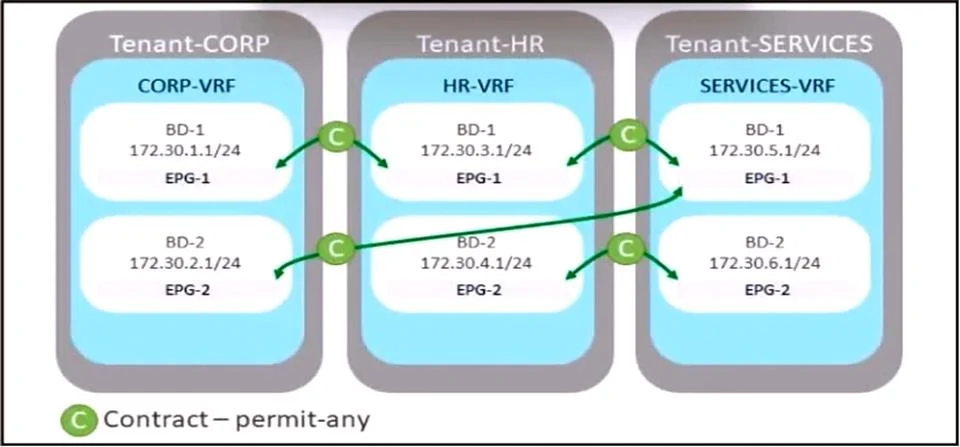
Options
- AConfigure an unenforced VRF in the user tenant and map all required EPGs to it.
- BImplement an enforced VRF in the common tenant and map all required BDs to it.
- CConfigure an enforced VRF in the user tenant and map all required EPGs to it.
- DImplement an unenforced VRF in the common tenant and map all required BDs to it.
How the community answered
(22 responses)- A9% (2)
- B18% (4)
- C5% (1)
- D68% (15)
Why each option
To enable seamless communication between EPGs and BDs across any tenant without explicit contracts or VRF route leaking, a shared, openly communicating VRF is required.
Configuring an unenforced VRF in a user tenant does not make it globally accessible to 'any tenant' without further sharing configurations, and EPGs are mapped to BDs, not directly to VRFs.
An enforced VRF still requires contracts for inter-EPG communication within the VRF, which violates the 'without configuring contracts' requirement.
An enforced VRF requires contracts, violating the requirement, and a user tenant VRF is not inherently shared across all tenants; EPGs are also mapped to BDs, not directly to VRFs.
Implementing an unenforced VRF in the common tenant allows for implicit communication within that VRF without the need for contracts, fulfilling the 'without configuring contracts' requirement. Mapping all required Bridge Domains (BDs) to this VRF ensures that all associated EPGs, regardless of their tenant, share this communication domain, making it accessible 'from any tenant' and eliminating the need for VRF route leaking between them.
Concept tested: Cisco ACI VRF types and common tenant scope
Source: https://www.cisco.com/c/en/us/td/docs/dcn/aci/apic/5x/p_guide/cisco-aci-programming-guide-501/m-vrf-networking-501.html
Topics
Community Discussion
No community discussion yet for this question.