
300-620 · Question #107
Refer to the exhibit, An engineer is deploying a Cisco ACI environment but experiences a STP loop between switch1 and switch2. Which configuration step is needed to break the STP loop?
The correct answer is C. Enable the native VLAN on the interfaces facing the MST switches using static pons in a dedicated. An STP loop between external MST switches connected to ACI can occur because ACI floods BPDUs within a bridge domain. To break this, enabling the native VLAN on the ACI interfaces ensures BPDUs are correctly handled and prevents unintended looping through the ACI fabric.
Question
Refer to the exhibit, An engineer is deploying a Cisco ACI environment but experiences a STP loop between switch1 and switch2. Which configuration step is needed to break the STP loop?
Exhibit
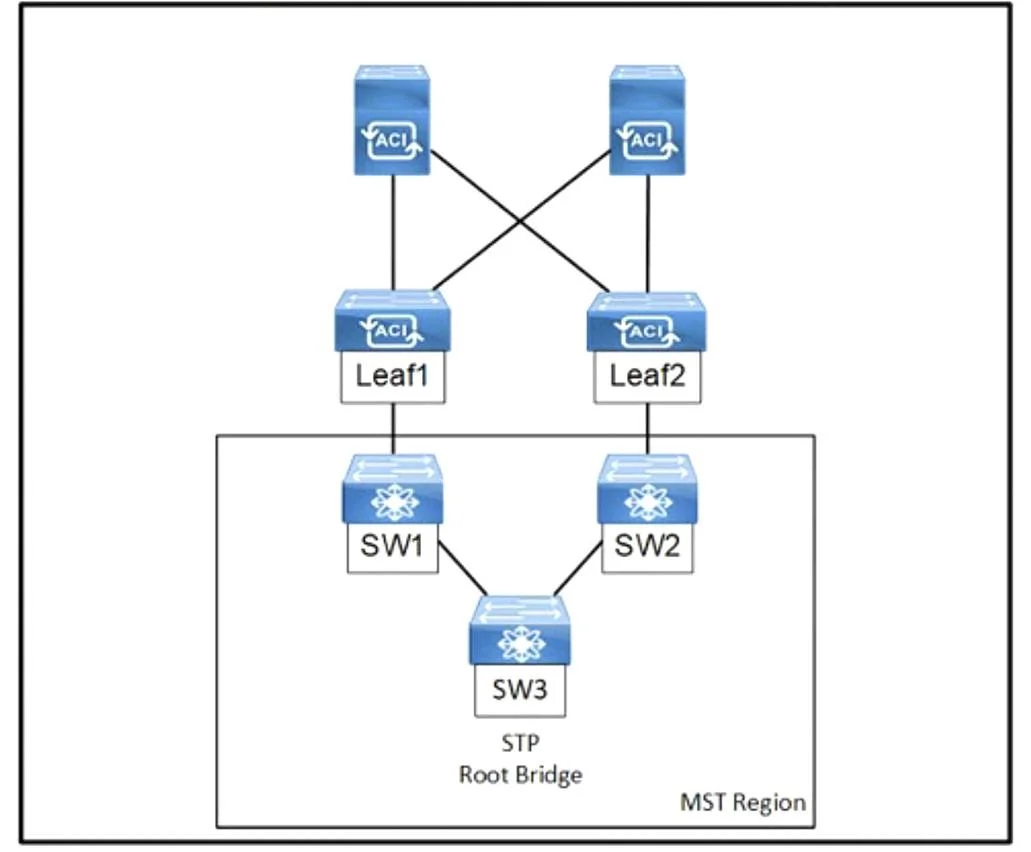
Options
- AConfigure the STP instance to VLAN mapping under the switch STP policy.
- BConfigure a Layer 2 external bridged network on the interfaces facing the MST switches.
- CEnable the native VLAN on the interfaces facing the MST switches using static pons in a dedicated
- DEnable BPDU filter under the STP interface policy on the Interfaces lacing the MST switches.
How the community answered
(37 responses)- A11% (4)
- B5% (2)
- C81% (30)
- D3% (1)
Why each option
An STP loop between external MST switches connected to ACI can occur because ACI floods BPDUs within a bridge domain. To break this, enabling the native VLAN on the ACI interfaces ensures BPDUs are correctly handled and prevents unintended looping through the ACI fabric.
Configuring STP instance to VLAN mapping is a task typically performed on the external MST switches, not within the ACI fabric itself, to resolve a loop through ACI.
Configuring a Layer 2 external bridged network is a general step for connecting external Layer 2 networks to ACI, but it does not specifically address or inherently resolve an STP loop.
Cisco ACI floods BPDUs within a Bridge Domain, and if two external STP-enabled switches are connected to the same Bridge Domain, an STP loop can form. Enabling the native VLAN on the ACI interfaces facing the MST switches, using static ports, ensures proper handling and isolation of untagged BPDU traffic, preventing the ACI fabric from becoming a loop path. This configuration forces ACI to correctly identify and process BPDUs on the specified VLAN, thereby acting as an STP boundary.
Enabling BPDU filter would prevent BPDUs from being sent or received on the ACI interfaces, essentially disabling STP's loop prevention mechanism on those links, which could lead to unintended consequences or not fully resolve the external loop.
Concept tested: Cisco ACI external STP integration
Source: https://www.cisco.com/c/en/us/td/docs/switches/datacenter/aci/apic/sw/3-x/aci-troubleshooting/b_ACI_Troubleshooting/b_ACI_Troubleshooting_chapter_010.html
Topics
Community Discussion
No community discussion yet for this question.